An Instrument Awakened
“When I first heard these instruments, I wondered why they were so quiet. Why didn’t they have more tone?”
by Steve Charles
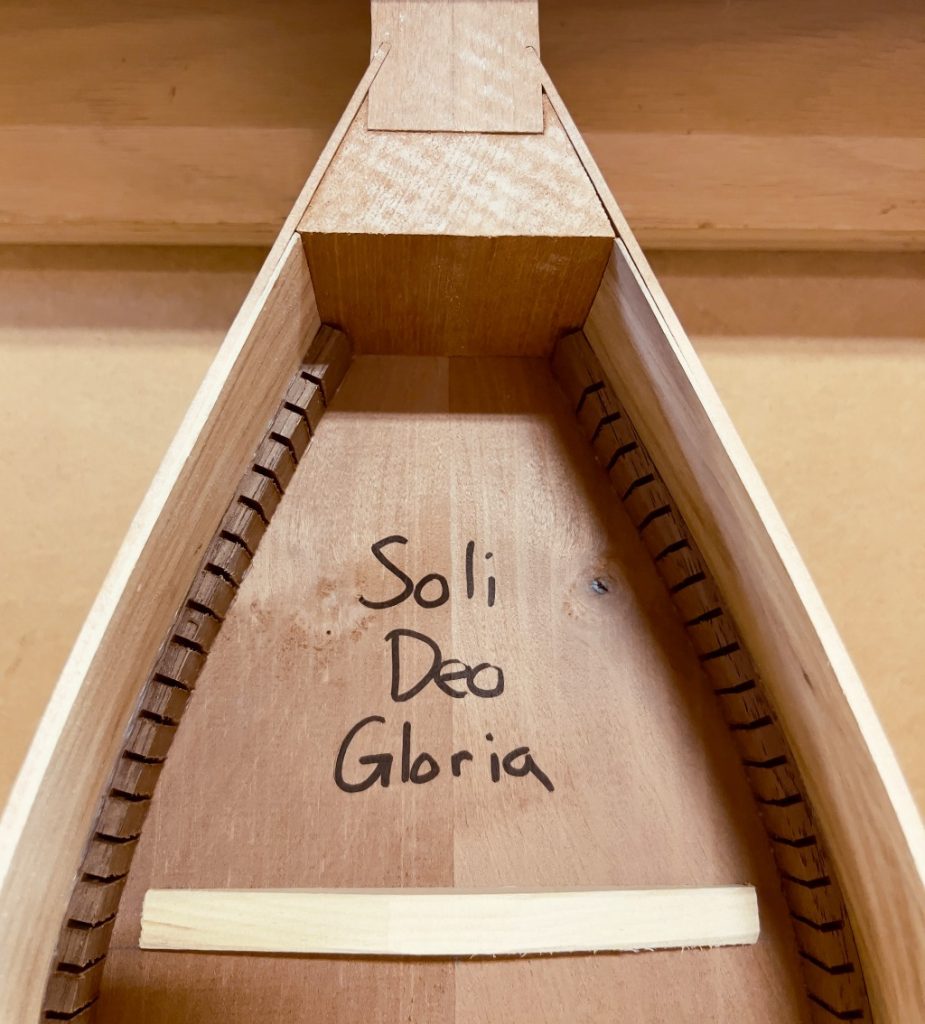
Soli Deo Gloria
It’s Latin for “Glory to God alone.” It’s what Johann Sebastian Bach meant when he wrote “SDG” on the music of pieces like “The Brandenburg Concerto” and “The Goldberg Variations.”
Rick Gooden inscribes the Latin words in full with a black Sharpie inside of every mountain dulcimer he and fellow luthier Rob Woodring build in their shop in the rolling hills near New Harmony, Indiana.

Photo courtesy of New Harmony Dulcimer Company
“Glory” may sound audacious for a humble wooden folk instrument, but it’s not far from what came to mind the first time I saw—and more importantly, heard—Gooden’s work in June of this year. I was searching for a special gift for a friend at Weedpatch Music in Nashville, Indiana, where a dozen or more dulcimers were hanging on the wall. The boldly streaked ambrosia maple top on the one from Gooden’s New Harmony Dulcimer Company caught my eye. As I sat down to play, I noticed the unusual design of the fretboard.
But it was that first strum that sang “glory.”
Mountain dulcimers are lovely, but notoriously quiet. The official state instrument of Kentucky, it has that soft Kentucky accent, too. Want to be heard in a mix of instruments? Don’t play a dulcimer.
But strum one of Gooden’s New Harmony dulcimers in your lap and gorgeous full-throated notes rise to your ears like an aural perfume that fills the room. Imagine holding a baby, expecting contented babbling, and hearing an aria instead. And the sweet sustain, even when you play quietly, allows a wider range of emotional expression, even with three strings in place of the traditional four. You hear the tone woods coloring the notes, feel the resonance through your skin.
A self-taught acoustic engineer with a perceptive ear and a zeal for research and innovation, Gooden has created a design that coaxes sounds from the mountain dulcimer I’ve never heard before.
So I’m alarmed when I begin my visit to his shop on a July afternoon and the luthier invites me into his small, glassed-in office and tells me he’s lost his hearing.
Sudden sensorineural hearing loss (SSHL) is the nightmare scenario for those of us already hearing impaired. You wake up one morning to the same near silence as usual, but this time when you pop in your hearing aids, nothing changes. Just that ringing inside your head and the silence around you. You replace the batteries, but still nothing. Your hearing is gone.
 For Gooden, the complete loss was in only one ear, as is mercifully the case with most SSHL patients. The condition is unlikely to strike the other ear. He says he’s grateful his hearing aid there gives him decent hearing for now. Other than not being able to tell which direction a sound is coming from—like losing your depth of field if you cover one eye—he’s doing fine. He’s working the problem with his doctors, coming at it with faith, phone calls, and a lot of research, online and off.
This afternoon he seems more concerned with the effect hearing loss could have on his other job, as pastor at Nobles Chapel Church in nearby Elberfeld.
“Listening is as important as speaking to my sermons,” he says. “I try to keep it interactive, I encourage questions. I need to be able to hear them.
“But this is the journey in front of me. I know my Lord Jesus Christ walks with me. I’ll do what I can to keep my hearing, but if I do lose it all?” He smiles. “Then I’ll be the Beethoven of dulcimer makers.”
Gooden’s optimism and drive to figure things out fueled his design of professional sound systems in a previous career, as well as a second one as a woodworker making doors, windows, and other architectural components for historic buildings throughout Indiana.
He brought the same hope and fervor the mountain dulcimer in 2013.
“When I first heard these instruments, I wondered why they were so quiet, why didn’t they have more tone,” says Gooden, a former brass player in the Coast Guard Band and other groups.
 He approached those questions like an engineer, an iconoclastic notion among most traditional folk instrument builders. The mountain dulcimer descends from instruments made in Appalachia by early settlers who didn’t have the tools, materials, or skills to build the more complex stringed instruments. Builders may have been inspired by European plucked zithers made in Norway and Germany, and the dulcimers’ shapes vary, but the basic components are little changed for the past 200 years.
That wasn’t enough for Gooden.
“I put my engineer hat on and asked myself, Why doesn’t the dulcimer sound better than it does? What causes these limitations?
“I started with a clean piece of paper. I looked at the dulcimer as a unique instrument with a particular sound. We don’t make guitars—our instrument is different.”
The first thing he noticed was that the fretboard usually runs the entire length of the top or soundboard of a dulcimer and is attached to a solid end block. That means the top can’t vibrate with the intensity it does in guitars and other stringed instruments.
“Actually, the back was vibrating more than the top, essentially serving as the soundboard,” Gooden says. “And once you put the dulcimer in your lap, you muted it even more.”
So Gooden allowed the fretboard to float on the top, not attached to the end block, so the soundboard could vibrate more freely.
Observing that intonation could be an issue, particularly when players switched to one of the many alternate tunings or changed string gauges, he created the Accutune Module adjustable bridge. Now the dulcimer can play in tune regardless of tuning or string gauge.
2007 National Champion dulcimer player Joe Collins, who Gooden worked with to test and tweak his theories on how to improve the instrument, calls the Accutune Module “simply brilliant.”
Finally, he acoustically aged the dulcimer by exposing it to the whole range of sound frequencies it might produce. He also found the ideal amount of time necessary for the optimum effect of the process.
“The molecules in the wood have to be in tension to get lively,” Gooden explains. “But it doesn’t have to be for as long as you might think.”
This afternoon in the shop, Gooden and Woodring are at work on a few of the 26-plus dulcimers currently at various stages of production. Lengths of sinker redwood, ambrosia maple, swamp ash, butternut, Peruvian and Ozark walnut, Bolivian rosewood, Pennsylvania cherry, bubinga, Harmonist poplar, and others line the walls. The smell of the shop subtly shifts depending upon the sawdust in the air; right now it’s the musky odor of walnut with a hint of redwood’s spiciness along with a touch of maple smokiness.
The model of each dulcimer—Brio, Whaletail, Command Performance, Bass, or Baritone—along with name of the customer it’s being made for—is listed on the large LCD screen glowing above the shop door. The choices of top and tone woods, along with requested options, are there too. At a glance, the luthiers can check the specs on any dulcimer they are working on.
The screen is one of the obvious 21st century additions to what you’d expect in a luthier’s shop, but Gooden and Woodring have either designed or modified almost every machine here to meet their needs creating these dulcimers.
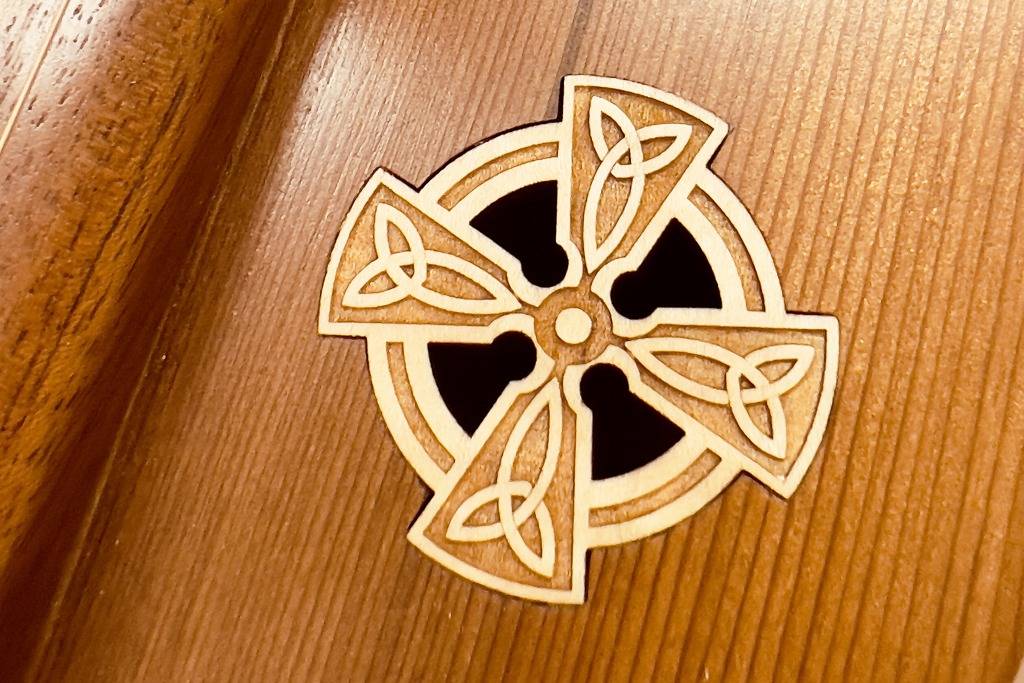
To help me understand and photograph the building process, Gooden is making a fretboard, while Woodring is creating maple soundhole covers on the CAD-driven laser cutter.
Gooden is focused and calm as he planes the solid piece of walnut, looking over the top of his glasses to check and re-check the height with a dial caliper until he gets exactly the height he wants. His pace is almost meditative as he moves first to the rotary sander to get the curve necessary on underside of the floating fingerboard, then to the bandsaw to cut string slots, then to the saw that hollows out the fingerboard. He’s hand sanding and filing in between steps.
 After several attempts not up to his standards, Woodring has made a breakthrough on the maple sound hole covers. He brings the precisely cut piece over to Gooden, who holds it in his hand, turns it and studies it, then nods and smiles.
A few minutes later, Gooden is done with the fretboard. I look up over my camera viewfinder as he holds the finished piece, complete with frets and position markers. He looks at me and makes a gesture with his hand—like he’s brushing dust out of the air. It’s a gesture I’ve seen from only one other person in my life—my grandfather made it whenever he was showing me how to do a job around the tack room or training the horses. It was a combination of encouragement (“it’s just that simple”) and pride (“that’s how it’s done.”) And Gooden’s got the grin to go with it.
This is a man who enjoys his work.
At 72, Rick Gooden realizes he won’t be making dulcimers forever. Woodring joined the shop a few years back to handle much of the building and, as the New Harmony website states, “has been training to continue the legacy ever since.”
Gooden’s particular way doing things extends to his relationship with customers. New Harmony Dulcimers have a lifetime warranty, and though I didn’t see any repairs being done in the shop, he says he welcomes them.
“It’s just another opportunity to get it right,” Gooden says. “To show our customers we really mean it when we say we stand behind our work.”
He has made a plan to transition the business to Woodring when the time is right. But nothing—not even a loss of hearing in one ear—will likely stop Gooden soon.
 “I’ve been lucky—been able to do almost anything I wanted to learn,” Gooden says. “I’d like to keep doing this as long as I can do it well.” The same goes for his work as pastor.
The two vocations—faith and music—fit together well. Maybe more so when the luthier inscribes his instruments with “Glory to God alone.”
“The glory of God is man fully alive,” said Ireneaus, a 1st century bishop of the then-new Christian church. And playing and singing music are two of the best ways we taste that liveliness.
“These dulcimers are my crazy ideas, but I love watching people play them,” Gooden says. “The dulcimer is the most personal instrument there is. You’ll see people who have never played an instrument pick one up and start to learn. And the dulcimer community is just wonderful—dulcimer people aren’t competitive the way players of most other instruments are. You’ll often see them teaching each other.”
“I love seeing the joy in people’s faces when they play.”