Confluence
Text and Photos by David Krohne
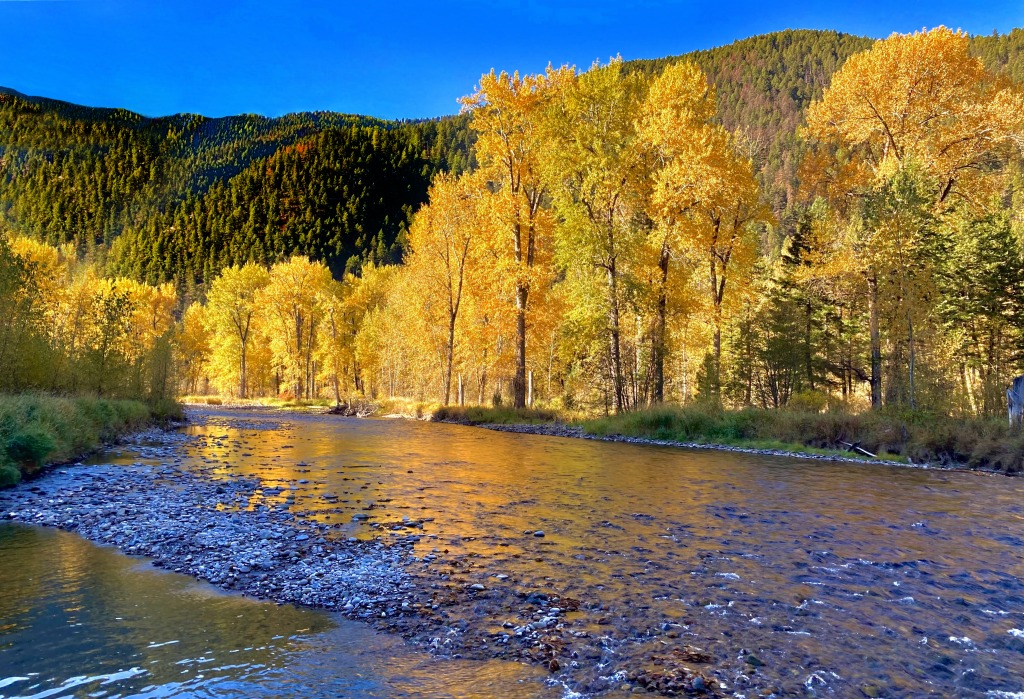
The Blackfoot River pushes gently against my legs, impatient for the sea. There are only two colors in the world—gold and blue. Cerulean describes the sky but I’ve found no word worthy of the gold of aspen, cottonwood, and tamarack. The passing water whispers and murmurs. Swirling currents paint abstractions in blue and gold on the mirrored surface. Expanding concentric rings push through the color fields as fish rise to the last mayflies of fall and sometimes to my imitation.
After a day like that, sleep was impossible. Eventually, I gave up and sat by the river in the darkness, trying to comprehend an afternoon so transcendently beautiful. Distorted reflections of stars formed, faded, and converged in the flowing blackness before me. How does such beauty come to be?
Water.
Water is the alpha and omega.
Orion rose in the east, sparkling as though brand new, announcing, as it does each October, that soon the last aspen leaf will flutter to the ground and the cerulean blue of fall will give way to the insincere blue of winter. The M46 Nebula in Orion glowed faint red and diffuse, in line with the crisp, blue-white stars of the sword. Stars are born there. Water too—enough to fill sixty Pacific Oceans every day. The violence that creates stars fuses hydrogen and oxygen to create all the water in the galaxy. At its birth, our own star cast water across the solar system. Some was captured by Earth as it formed. More came via comets and asteroids. Imagine how many comets, those random, sporadic visitors, must have come to Earth to fill the Pacific Ocean and feed the Blackfoot.
The water flowing past me is ancient, closer to the sun’s age than the earth’s. It cycled from primordial oceans to mountains to rivers for more than four billion years before the first mayfly fluttered above it. It was another 140 million years before the first trout rose to sip a mayfly, another ten million before the Blackfoot first flowed from the nascent Rocky Mountains and the first cottonwoods and aspens were reflected in its waters. And it was another 50 million years before a trout was fooled by that pinnacle of evolution, a dry fly fisherman.

There is a moment of exquisite beauty that brings me back to the river. As the fly passes over an unseen boulder, a deep-green shadow rises from the deep, pauses and the fly disappears in a swirl of brilliant colors. The “take” requires just an instant but the memory of it stretches out in slow motion. If I’m lucky, I’ll hold those colors in my hands for a moment.
We can thank the mayflies’ long, convoluted history with water for that moment. Mayflies first evolved in water, moved to land, then returned to water. But their adaptation to the aquatic environment lagged behind. The result is an awkward, perilous transformation from an aquatic nymph to a winged subadult at the water’s surface. When it reaches the surface, the nymph must break free from the nymphal case, break through the surface tension, and unfurl and dry its wings before it can fly off. The transition from nymph to winged subadult is fraught. Many become stuck in the nymphal shuck, unable to pull free. Others cannot break through the surface tension and drown. Some reach the surface only to have the wind or waves push them back into the surface film. Mayfly evolution could have followed many different paths. But it followed the one that led to the swirl of a rising trout.

Underlying all of this, literally, is the odd physics of water where it meets the air. Water is a polar molecule: one end is positive, the other, negative. Adjacent molecules attract and bond with one another. Those bonds are particularly strong at the interface of air and water. The result, surface tension, is a boundary layer strong enough that small objects denser than water, such as a bundle of feathers hiding a steel hook, will float. It is that surface film that mayflies struggle to escape. The combination of the strange evolutionary path of mayflies and the physics of water, create the most elegant way to catch a trout—casting a dry fly to rising fish.
In the darkness, the Blackfoot whispers softly. This afternoon, it murmured and gurgled as it parted around my legs. These are soothing sounds, gentle on the ears. But there are other sounds on other waters. At Lava Falls in the Grand Canyon, the crash of tons of water on bedrock is terrifying as you hurtle toward the horizon line. The roar is relentless but tune that out and you hear the constant grinding and tumbling of boulders deep in the water, unable to hold against its force. On a tiny granite island in Quetico, crashing waves announce, “You aren’t paddling today”. Once on a remote river in Alaska, I woke to what sounded like someone dropping bowling balls into the river, over and over. I finally braved the mosquitos and walked down to the river in the half light. A pod of silver salmon, fresh into the river on the last high tide, was holding in an eddy next to camp. For reasons known only to them, they were breaching, leaping, and tail slapping.
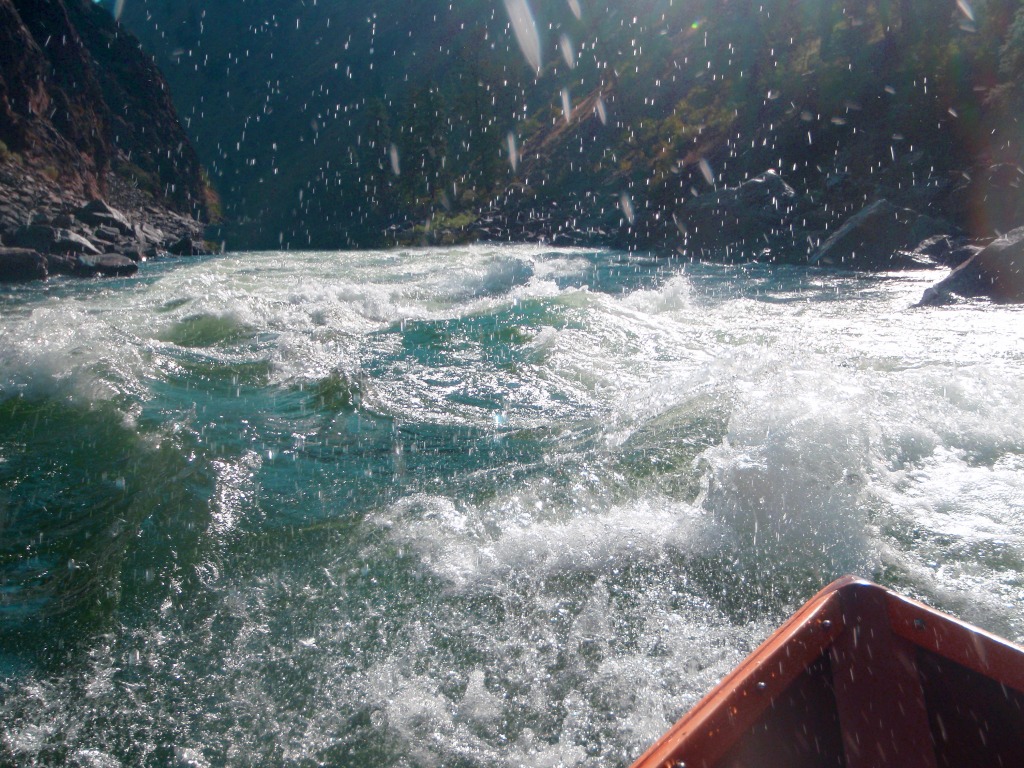
Water alone makes no sound. The whisper of the Blackfoot and the roar of Lava Falls require some other object—a fisherman, a boulder, bedrock—to produce sound. Stand below the lip of Yosemite Falls, where the water pours out, away from the wall. All those tons of water passing in freefall make no sound. All you hear is the distant crash of water on the rocks a thousand feet below.

The visual beauty of water also requires something other. Picture the most exquisite colors you’ve seen in water. They are not the color of water but something the water carries within it. The aquamarine of Havasu Creek in the Grand Canyon is the color of the minerals it leeches from sandstone.

Grand Prismatic Spring in Yellowstone takes the color of ancient microorganisms adapted to water near the boiling point.
Light too, is part of this aesthetic synergy. When light strikes water, it is both reflected and refracted. When the sun peaks out beneath storm clouds at just the right angle, trillions of raindrops, each a tiny prism, bend and split sunlight into the colors we see as a rainbow. Reflected light, especially low angle light, is polarized, intensifying the colors of the Blackfoot on an October afternoon.
But of all the sensory gifts we receive from water, none matches its touch as it pushes softly against my legs. The touch is personal, intimate, sensual. It is not a caress—a caress is ephemeral. Water eddies around my legs and passes on, but the sensation never wavers. The light shifts, the sound of the river rises and falls with the wind, but the push of water is constant, insistent. Hours later, if I close my eyes, I’m still leaning slightly upstream, into its touch.
Fishing is my teacher in the way of water. The Blackfoot is the union of all the paths its waters take—its currents, riffles, seams, and eddies—separate yet one. Its beauty too is a confluence—of ancient water, physics, and evolution. It is the whisper of water, the gentle, relentless seaward pressure, the reflected incandescent gold of cottonwoods, the ripples of fish rising to sip mayflies. And I was present at this gathering. When I touch the Blackfoot, I enter that confluence and my consciousness dissolves in flowing water. It is an immersion, a baptism. In that moment, I am reborn. And I whisper my thanks to a god unknown.
