Yellowstone Trilogy, Part Three
An Inordinate Fondness for Bison
Wake up before the bison jams, leave the road, and rediscover wonder in the stories the Yellowstone landscape has to tell.
Text and Photos by David Krohne
When a vicar asked the evolutionary biologist J.B.S. Haldane what the study of evolution reveals about the nature of God, Haldane replied, “That he has an inordinate fondness for beetles.” His quip was based on the extraordinary abundance and diversity of beetles, some 400,000 species and 25% of all animals.
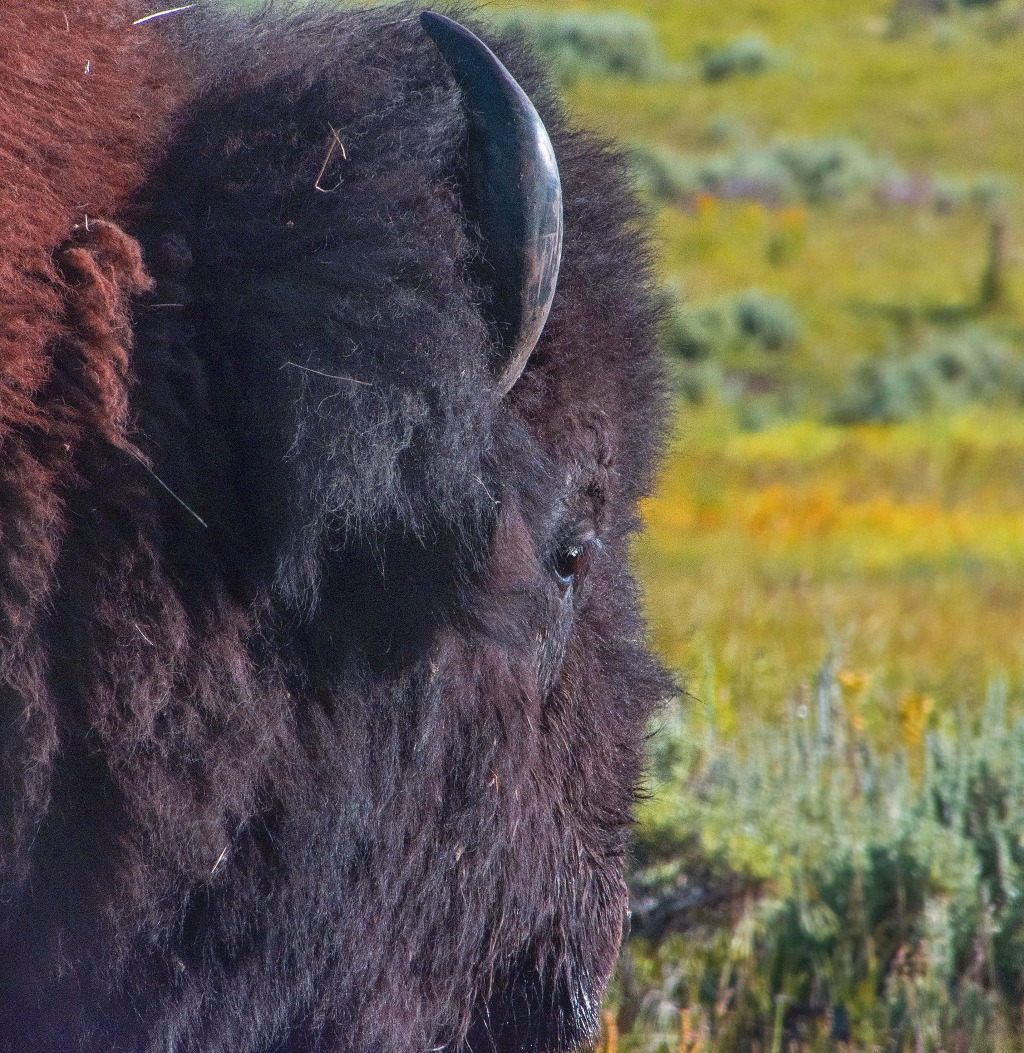
If extraterrestrials were to study Earth and humans by analyzing the data we store in the Cloud, they would conclude that humans have an inordinate fondness for bison. More pixels are devoted to bison photos and video than any other wild animal on earth. No other species combines their abundance, visibility, charisma, and availability along the roads of Yellowstone, where four million people vacation every year. A drive almost anywhere along the Grand Loop Road is repeatedly interrupted by bison jams—dozens of cars and hundreds of people lining and blocking the road to take photos and video of bison. As you wait at the next jam, you will see the same people you saw at the previous jam doing precisely the same thing they did a mile back.
I’d made it from my camp at Baker’s Hole to the Lamar Valley just as the sun lit the summit of The Thunderer and long before the first bison jam of the morning. Fly rod, bear spray, camera, lunch, and I was off. Two hundred yards later, I was stopped in my tracks by an old bull bison. I thought I’d given him plenty of space, but he stood up and gave me the stink eye. I apologized and promised never to eat another bison burger and he lay back down with a grunt.
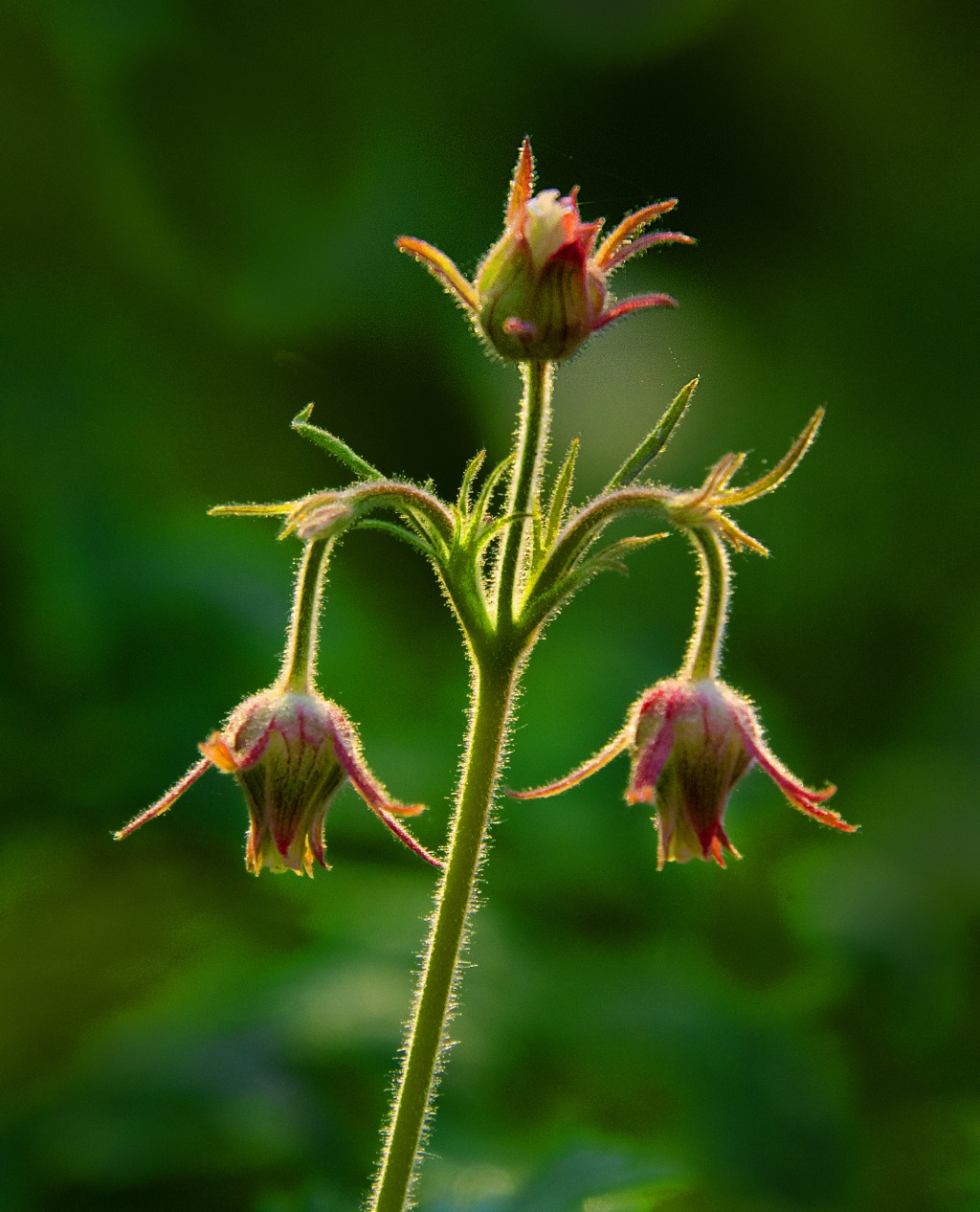
As I turned to move on, I was stopped again, this time by a wisp of backlit smoke—the seed heads and namesake of Prairie Smoke. I flashed to another time and place—a Minnesota prairie remnant and first light in a field of Pasqueflowers and Prairie Smoke. Here was a defining plant of the northern tallgrass prairie, just shy of the Continental Divide, in a sage steppe bordered by spruce-fir forest.

So? The plants that comprise “prairie” have more than their share of biogeographic anomalies—Little Bluestem on Long Island, Fringed Puccoons in New Mexican red desert, Pasqueflowers along the Clark Fork in western Montana. “Prairie plants” thrive in places no one would call prairie. A fundamental paradigm of plant ecology, and a psychological comfort important to plant ecologists, is that plants are found where they belong, within their normal ranges, with their normal associates, as part of a well-defined plant community. These little wisps of smoke were a reminder that in decades of studying prairie, I had found little comfort.
I lay on my belly, peering through my camera’s viewfinder. From that perspective, the U-shape of the Lamar Valley, the signature of glacial topography, was exaggerated. My Prairie Smoke was isolated in little pockets of loess, the ultra-fine mineral soil, carried into the valley by the Lamar glacier. Prairie Smoke in Yellowstone loess is simply a reminder of just how young this landscape is. Order, patterns, and consistency, require time. The Lamar and its plant assemblage is less than 10,000 years old. The prairie of the Great Plains and Midwest is even younger, perhaps 9,000 years. Prairie Smoke arose from arctic species fifty million years ago just as the Rocky Mountains were rising. It eventually made its way down the new mountain chain to colonize montane meadows. When the Pleistocene ice advanced, the plants took refuge in small, ice-free pockets. When the ice melted, Prairie Smoke left its refugia to colonize valleys like the Lamar and eventually the nascent prairie to the east. There, it is an ancient species in a new landscape, part of a novel community of immigrant species, all unsorted by ecology or evolution.
Botanist and ecologist Henry Gleason, whose thinking was nearly 100 years ahead of its time, wrote, “Are we not justified in coming to the general conclusion, that a plant association is…. merely a coincidence?” Here in the Lamar Valley I was lying on my belly in a coincidence of Great Basin sage, alpine Douglas fir, and Prairie Smoke from the tallgrass.

Swarms of little yellow mayflies known as pale morning duns buzzed over the Lamar and the river was dimpled with rising trout. But not just any trout, the Yellowstone cutthroat—the trout described by Lewis and Clark, (Oncorhynchus clarkii), to my eye the most beautiful fish in the world..Their closest relative, the West Slope Cutthroat, is a fish of the rivers that drain to the Pacific. But the Yellowstone Cutts live in waters that will reach the Gulf of Mexico via the Lamar, Yellowstone, Missouri, and Mississippi.
They are as new to the Lamar as Prairie Smoke and as intimately connected to Pleistocene ice. Their ancestors from west of the Continental Divide gradually made their way up the Columbia to the Snake and all the way to its headwaters just south and west of Yellowstone. As they adapted to this world, they gradually diverged from their cousins as a distinct species. When the ice dam that impounded the enormous Pleistocene Lake Bonneville failed, a torrent rushed down the Snake and formed Shoshone Falls, a 200-foot barrier that isolated the new species in the upper Snake. If you follow the Snake upstream far enough, you come to Two Ocean Pass just outside Yellowstone. There, Two Ocean Creek (discovered by, who else … Jim Bridger) splits over a small ridgeline into Pacific Creek that flows into the Snake and the Pacific, and Atlantic Creek, that flows into the Yellowstone and on to the Atlantic. Yellowstone cutthroats swam up the Snake to Two Ocean Creek, crossed over into Atlantic Creek, and colonized the Yellowstone country where today I can touch a young, beautiful fish in a young, beautiful landscape.

I’m always reluctant to stop, even to eat, if there are fish rising. But when I finally did that day, I sat down next to a relic of a much older Yellowstone. Among the cobbles at river’s edge was a chunk of petrified wood. No doubt it washed down from the petrified forest that stands along Specimen Ridge a few hundred feet above the valley floor. Yellowstone is full of wonders, but its petrified forest is the equal of the geysers, falls, and hot springs. Among the fossils on Specimen Ridge are 50-million-year-old Redwoods, the remains of a lush forest that flourished here in a cool, wet, Eocene forest. A series of volcanic eruptions buried the trees in lava and ash. Ever so slowly, silica replaced the red wood. They stood there, trees of stone, for tens of millions of years, buried upright, roots in the ground, until erosion exposed an ancient forest of trees as old as starlight.

The Yellowstone landscape is as old as it is young. It is rich with stories. But the stories emerge only if you actively engage the landscape. I have nothing against bison; they’re worthy of the attention they get. And they have their own stories to tell of time and evolution and survival.
But if a bison jam and a big bull walking inches from your car is your Yellowstone story, I feel sorry for you. For too many, that is their only Yellowstone story. For the complete, stupendously impoverished experience, drive the Grand Loop, preferably in one day. Check off Old Faithful, a few hundred bison, the Lower Falls, the Grand Canyon of the Yellowstone, and Mammoth Hot Springs. Engage everything through the screen of your cell phone. Return to West Yellowstone by late afternoon to eat an ice cream cone and buy a T-shirt.
Then go home, look at your selfies and videos to find out what you actually saw, and complain about the traffic, the road construction, and the price of a motel, to anyone who will listen. When I tell you I love Yellowstone, roll your eyes and tell me you’ve “done Yellowstone”. Turn the place into a caricature of itself. Jellystone National Park.
Yellowstone has an image problem: there are just too many of them. They’re ubiquitous. You know what you’re going to see before you ever get there. All those images desensitize us. There is no magic, no awe, and you come home with just another banal image of Mammoth Hot Springs, the Lower Falls, or the Grand Canyon of the Yellowstone. Or a selfie in front of Old Faithful. The only thing these photos document is the death of wonder. The mental images are worse—a mile of cars waiting to enter the park, gridlocked parking lots, endless bison jams.
But images that capture wonder—they are the pearls of great price. You can’t buy them in the gift shop. They are found objects. They might be recorded in a camera, in a poem, in a painting, or in a song, but they are not your creations. They are given to you in the stories the landscape has to tell.
My images are of the most beautiful fish in the world, wisps of Prairie Smoke, and ghost Redwoods. Don’t dwell on them—they’re mine, no more relevant to your experience than a postcard. To find your own, you’ll have to begin the day in the dark when it’s just you and the elk on the Grand Loop Road. Watch sunrise over the caldera from Dunraven Pass. Or through the steam at Grand Prismatic Spring. Or from the meanders of the Yellowstone in Hayden Valley. Then leave the road and walk, off-trail, into a meadow, as far from the road as you’re comfortable. Take your field guide to the wildflowers or the insects or the birds. Or your journal. Or sit quietly, absorb the soundscape, and imagine a melody. Scan the ridges with binoculars for anything other than a wolf or a bear.
The stories are there, waiting. They will come to you. And through them you’ll find an image to embrace, the reflection of the landscape on your soul.
And along the way, take some photos of bison. They’re pretty cool.