Grace Notes
Why do we love birdsong?
by David Krohne
On March 21, the sun crosses the celestial equator and, on that day, the calendar says spring begins.
The white-throated sparrow in the fir outside my window disagrees.
Spring begins when he says it begins. I mark spring from the day I first hear that sweet, eight-note whistle. An astronomical definition of spring is useful if you’re a Druid engineering Stonehenge or an Inuit anticipating the first sunrise in six months. But the white-throated sparrow’s announcement more accurately forecasts the first shooting stars in my meadow, the first spotted fawns hidden in the grass, and when it’s time to get serious about morels.
Almost all birds sing in the spring but most simply cannot be trusted to mark the start of spring. More often than not, when I hear the first red winged blackbird of the year, it is hunched on top of a cattail in a late February blizzard. But by God, he got there early enough to get the best territory.
One warm morning a male calliope hummingbird chatters at me from the pole that normally holds our hummingbird feeder. I indulge my anthropomorphism to imagine his indignance: “I’ve just flown 600 miles. Would it be too much to ask…?”. But the next day hoar frost grows on the feeder and I won’t see him again for a week.
When I wake to the first “killdeer killdeer”, spring is already feeling more like summer.
My notes tell me that even though the first white-throated sparrows have arrived as early as the last week of March and as late as the last week of April, they’ve never been early or late.
My sparrow also heralds the richest soundscape of the year. This is the season of the dawn chorus, when every male songbird advertises the bounty of his personal realm and the wonder of his genes. I still perform the Aldo Leopold ritual of rising in the dark to mark the first song and anticipate the coming crescendo. Two enterprising ornithologists combed through Leopold’s field notes to reconstruct, from modern digital files, the dawn chorus he would have heard at the Shack in his day. Set your alarm for 4 a.m., put on the coffee, get out your field notes, sit on the back steps, and listen. Compare your chorus with these five minutes from his.
Gobbles, caws, hoots, warbles, chirps, shrieks, clucks, peents, honks, quacks, and whistles are the soundtrack of time well spent, that is, time spent outdoors. Our reaction to the soundscape is personal, often idiosyncratic. Years ago, when Minnesota was choosing a state bird, the vote came down to the black-capped chickadee and the loon. A reporter asked an old trapper which he would vote for.
“The black-capped chickadee,” the trapper replied.
“But everyone associates the loon, especially its call, with the North Country,” the reporter said.
“Yeah, but when it’s 30 below and I’m out chopping wood, the chickadees are here, keeping me company and singing to me while I work. And where is the loon? In Florida, shooting off his big mouth!”
Every field biologist I know is attuned to the nuances of the soundscape. One Sunday in April, my 88-year-old friend and mentor, Pete, called. “Hey Dave! Are you watching the Masters on TV?”. “Uh, no. I don’t watch much golf”. “Well, turn it on and just listen. They have all these microphones at the tees. Then call me back”. An hour later we were talking about the Georgia dialect of the cardinals singing in the background, how it differs from the Midwest song, and wondering where the boundary between the two might be.
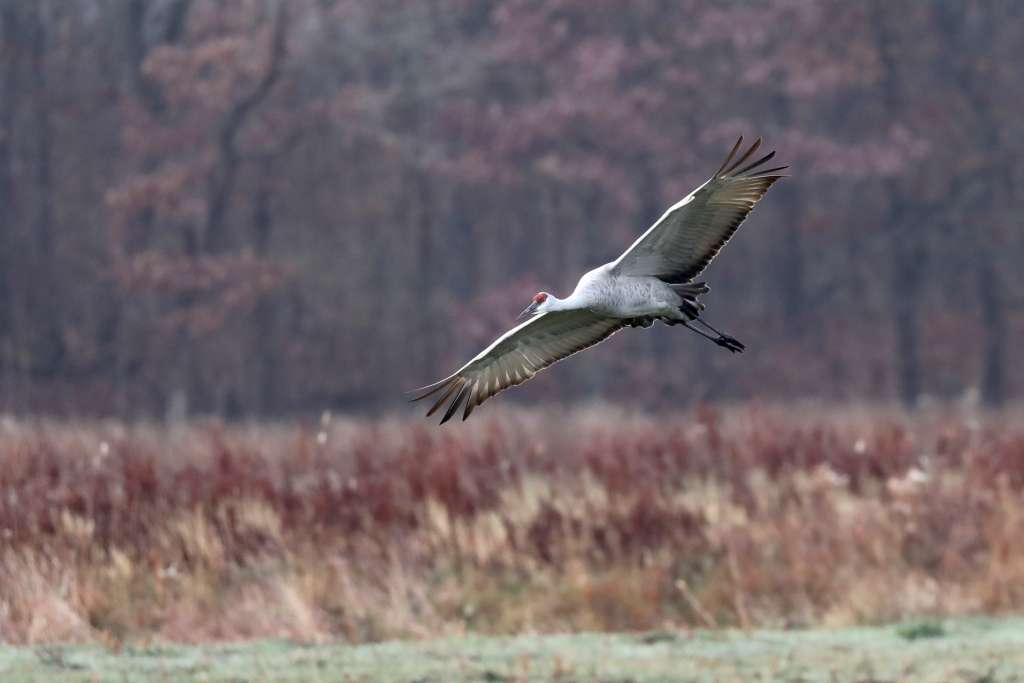
Make listening a habit and you’ll find songs that stand apart. The sandhill crane’s bugling is one. I never hear a crane without scanning the sky for the spiraling flock. Despite its winter fecklessness, nothing evokes place like a loon calling from a mist covered lake. I’ll offer three others that are truly sublime. The canyon wren’s unadorned cascade of notes evokes a Native American flute. Or rather, the flute evokes the wren. The hermit thrush’s liquid melody contains its own echoes. And the white-throated sparrow’s thin whistle is somehow both haunting and joyous. No string of notes Chopin wrote surpasses these three melodies.
For sixty years we have known that bird song is partially genetic and partially learned. Birds inherit a song template but must hear an adult singer to perfect the song. A Georgia cardinal raised in Indiana would sing the Hoosier dialect.
Playback experiments illustrate the behavioral effects of song. Play the song of a red-winged blackbird in another’s territory and the outraged male attacks the speaker. Recent experiments produced results I never would have imagined. If you digitally re-order the notes in a bird’s song, it elicits the same response as the actual song. The notes are more important than their order. Moreover, between the notes are dozens of additional sounds, just one or two milliseconds long, in frequencies beyond human hearing. They contain all kinds of information regarding the singer, including breeding status, condition, and individual identity. Bird song is produced by the syrinx, a two-branched structure above the lungs. The two branches simultaneously produce independent, one or two millisecond bursts of sound, thanks to muscles that contract faster than any other vertebrate muscle. Think of that when you watch the wingbeat of a hummingbird.
Why do we love birdsong? Is it purely the song itself, independent of its origin and its biology? Is it the similarity to what we find beautiful in the music we construct, an aesthetic shared by Chopin and the canyon wren? Isn’t that just a form of anthropomorphism? Or worse, anthropocentrism? Sometimes, as Henry Beston reminds us, we need to remember our place in the long parade of life.
For the animal shall not be measured by man. In a world older, and more complete than ours, they move finished and complete, gifted with the extension of the senses we have lost or never attained, living by voices we shall never hear.
All of us, humans and the plants and animals we call Nature, are intimately connected by a long, shared history. It is right and proper to think of ourselves as just another animal. But in our conceit, we impose our own relational constructs on our fellow creatures. In our arrogance, we imagine that the beauty of their music is that it echoes the beauty of ours. The canyon wren, the hermit thrush, and the white-throated sparrow are sovereign worlds, each spinning on its own axis, tracing the curve of its own orbit. I treasure those moments when our paths cross, such as on a bright April morning when a white-throated sparrow announces, in eight familiar, whistled notes, the arrival of spring.