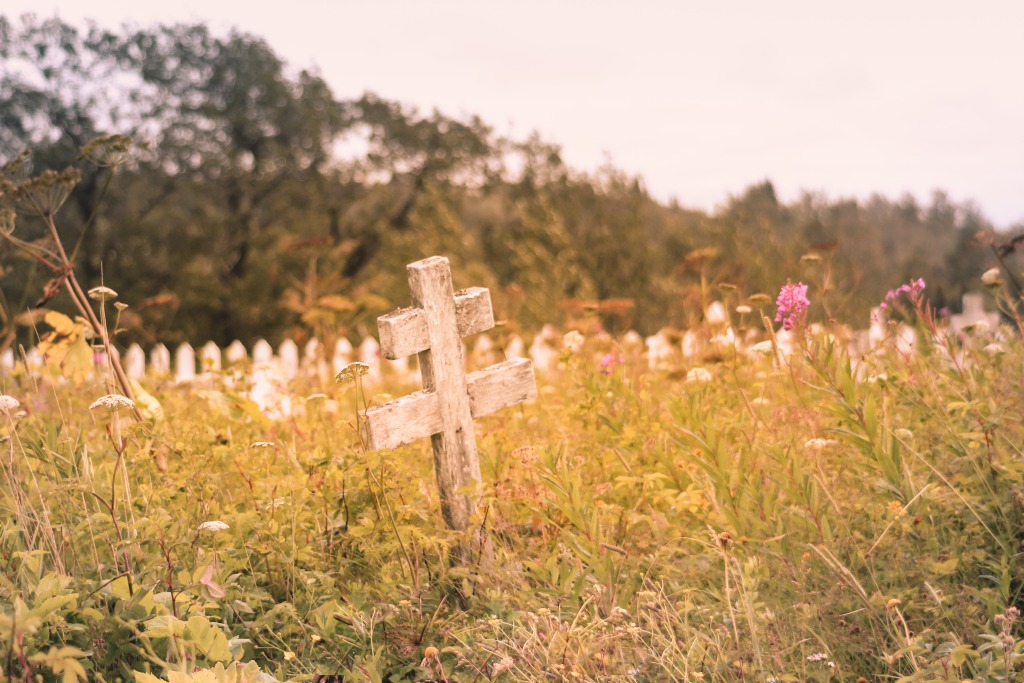
Infant Burial
We peer into the gaping hole, so small, so deep. My heart like a cloud breaks . . .
by Maria Reynolds-Weir
I hesitate to take my turn shoveling dirt over Elijah Matthew’s shoebox coffin because I am not one of his mother Hannah’s close friends. I know her because we attend sister churches. Other women, not I, have been ministering to her since Elijah’s heart stopped in utero at sixteen weeks gestation. It has taken four weeks for her body to relinquish Elijah’s, as if her mother’s flesh held on to the hope of his life.
Hannah and her husband, Will, along with her friends and our parish members, now stand graveside for the second burial in the cemetery Holy Transfiguration established in this fallow field last autumn. Two dozen small children, the trust of the two communities, which Elijah Matthew would have joined, kick clods. We adults wish we could.
Hannah’s brother opened the earth earlier in the afternoon. We peer into the gaping hole, so small, so deep. My heart like a cloud breaks as soon as Will, Elijah’s father, kneels and reaches to his shoulder to settle the white shoebox in a hole deeper than it is wide. When he stands, dust clings to the knees of his slacks. He slaps the earth on his palms against his thighs and beats it off his knees and legs.
Three priests wait for his eye contact as if to say, “Ready?” Then Father Alexis, Hannah’s dad, intones the final prayer, chanting first: “Holy God, Holy Mighty, Holy Immortal, have mercy on us.”
As rector, Father Alexis serves this interment for his seventh grandchild. As first priest, he shovels the first dirt, a hollow hit on the cardboard. Faces ache, mouths clamp, empty of words.
I find myself sneaking peeks at the forty or so faces in a crescent around Hannah and Will. Hannah’s eyes shine, her lips flush red as her hair. I try to step inside her head, to imagine her thoughts, but only questions bloom. How would I feel carrying my stillborn child for so long? Would grief roll down like mighty waters? Would it compound with each passing day? Would I find myself angry that this child overstayed its welcome? Would I be eager to bear down when my uterus finally contracted? Would I weep at the futile work or rage at the imposition? What of the possibility of sepsis? If she harbors fear or anger, her face betrays no such poison. She cradles her three-year-old Michael in her arms.
Father Alexis passes the shovel to the second priest, Father Gregory, white-bearded and monkish, while Will waits his turn, holding his daughter Mia’s hand. Her curls, sweaty and dark like her father’s, press against her forehead. She stares, curious, as the third priest, my husband, Father Joel, tosses a small scoop. Who can bear to dump heavy clay, still smelling of the field once fertilized with dung, on a baby’s body? The hollowness of the box reverberates as clods thud. Blond dirt mingles with the gold threads on his white vestments. Priests wear white “For the resurrection of the dead,” though under the white brocade they wear black.
Once each priest helicopters the shovel over the hole, Will’s dad, Deacon Basil, takes his turn. Then Will. More soft pops crack as clay smacks cardboard. Will’s tall straight form, an athlete’s trained posture, curls into itself when he hands Hannah the tool returning their stillborn son to dust. Interminable plopping starts to sound like raindrops.
Everyone will take a turn. This is how it works in a traditional Orthodox Christian burial. Mia needs her father’s direction as she wields the shovel. Will provides the leverage for her, then he helps Michael steer the gardener’s tool. Then Will extends the handle to his mother. There’s a split second when I wonder if we’re complicit in a grievous finality or if we’re travailing as Hannah had done just days earlier. Bear one another’s burdens out of love. Justin, Hannah’s brother, hefts it, then hands it to his petite wife, Anne. After her turn, Anne helps their eight-year-old Nektaria. Their other children are far too small to try.
When the family finishes, we take our turns. Anne’s mother, as diminutive as her daughter but with salt in her dark hair. Next Maura steps forward. She doesn’t yet know she’ll miscarry babies twice in the following months and become Hannah’s sister-in-grief.
Each load of dirt disappears Elijah’s name, spelled out by a child’s hand with a bright purple marker.
Then husbands who work or pray or play with Will throw a load — a college dean, a meat inspector, a programmer, an appliance repairman, an accountant—followed by their wives. Father, mother, dad, mom, poppa, momma. Even after most of the mourners labor, even then the hole is only half full. Stalled like a watched pot, Thor’s horn, never empty, never full.
I am doing a lazy sway with one of the babies on my hip until the previous grave-filler casts about with eyes and arms, almost dropping the shovel he tries to plant in the dwindling reserve of dirt. I shrug the baby back into its mother’s arms, and I join myself to the community. Only a few others have hung back with me. They follow before Father Gregory steps forward to retrieve the tool to finish the job, but Will intercepts it.
“Please.”
Something like defiance shows on his face. I think there’s both a plea and a demand in him. Father Gregory clutches the wood, reluctant to relinquish the bulk of the burying to Will, but he’s not prepared to say no. Will’s lean ex-baseball player strength finds familiarity in the swing and turn. He heaves again and again, reducing the fresh dirt to nothing, scraping the topsoil off the land beside the grave. The grass faints. Hannah may have made peace with this loss—the luck of being a woman is that she could have, or perhaps has done, so much grief work before this ceremony—but here Will seems intent on working out his anger and hurt until Father Gregory steps forward, commanding with his gestures. No one has the moxie to intervene or leave except Father Gregory.
“Give me the shovel, Will. It is finished.”
Another toss. Will takes a moment to listen. A breath. Perhaps we should have let Will dig through his grief in silence, but no one could leave him alone in his anguish. We don’t move. We bear witness to his energies, the essence of what’s in his heart. Perhaps he is burying it in this hole he’s laboring to close.
Whatever his feelings about the stillborn that his wife’s body didn’t want to yield, potentially threatening her life, turning her into a walking grave for a month, the child they got but didn’t get, Will throws everything, every last retrievable bit, on the mound.
We swallow the bitter in the back of our throats before linking up around Will. I cannot cry, and I consider that Baby Elijah, too, never drew in a breath and squalled. At that moment, I didn’t consider Baby Elijah’s consciousness, because I, like most, supposed that even the Christ Child couldn’t string together thoughts and recall them in the womb. Later, I will imagine that Elijah’s brain and heart stop in the warmth, blanketed in the fading vibrations of Hannah’s voice. Yet hard and small as a fig, yet unripe to open milky blue eyes and part lips to suckle, yet without onion skin nails on his fingers and toes.
In the Old Testament, a woman bore a judgment on the fruitfulness of her womb. In the Gospels, Christ cursed the barren fig tree. If we misread these narratives, the metaphors might close us off from bearing one another’s griefs out of love. Church people like to chide, or maybe coach, each other on what meaning to make of senseless loss rather than abide with the grieving as they they their pain.
Yet Mary, the mother of Jesus, stood there, bearing witness, as her son died on the cross.
We would not let Will and Hannah alone. They opened up their grief rather than mourn in isolation. Here in this liturgy of loss, more congregants of our two churches have shown up at Elijah’s funeral than showed up for the year’s liturgical feasts. I’m glad of it. Those feasts with all their services teach us what to look for—Christ—but often we don’t see Him until we look upon the face of pain. The last of what most humans saw of Christ was corpse and corporeal, pierced, pieced up. Only some saw him resurrected, and those who did put their fingers into his wounds.
A mercy meal follows most funerals, even for stillbirths, if that comforts the family. We cling around Will and Hannah on the walk into the parish hall, processing past the plastic farm tub used for baptism, turned over on the push mower in the back of the church.
Heads bowed, we stumble toward cakes and casseroles, humble 9x13s of church lady meals, salads of garden vegetables we’d grown. Eating that meal, we acquiesce to go on living, albeit with hurting hearts.
No matter how she tries to avoid the macabre and sorrowful, Maria Reynolds-Weir assays on grief, family, life and death. She holds an MFA in writing from Chatham University. Her works, from poetry to fiction to essays, have appeared in the Vonnegut Library’s So It Goes and Poetry of the South, The Handmaiden, Relevant Magazine, and Macrina Magazine. She’s a regular columnist for her county’s League of Women Voters.
Please send any comments to the editor: charless@wabash.edu