
Melancholy Days
The landscape changes with the seasons, but the missing doesn’t.
by Kelly O’Dell Stanley
In late fall, early winter, I see Dad all around me.
Literally.
I drive the fifteen minutes from home to the studio, watching the landscape gently undulate around me. But I see it as though it’s a painting. The slashes of sepia and raw umber defining the fence line, from which the bare branches of the trees reach up into the cerulean sky. The Naples yellow and sap green, intertwined like some kind of scratchy camo, the detritus of the harvested fields and dying grasses.
The sight of it all evokes such a visceral longing I can hardly catch my breath.
And it reminds me how lonely I am. How much I miss him.
Most of the rest of the year I miss my mom, but right now, all I can see is him. It’s a privilege to be able to see the world through eyes like his—the same dull, dark brown, the same eye for composition and light and shadow. But at the same time, it reminds me just how lonely this life is that I’ve stepped into. I’m like a kid playing grown up. Wanting to feel connected to my daddy. I have his walls, his building, literally surrounding me every day. His art decorating those walls. Friends who knew him nodding at me from the street as they walk past.
But he isn’t here. He will never be here. The landscape changes with the seasons, but the missing doesn’t.

Fall is my favorite, but in winter, I see a lot of Dad around me, too. Winter strips everything down to its bare bones. If an artist doesn’t understand the structure beneath, they can’t portray it in a realistic way, and in the winter, what lies beneath comes to the forefront.
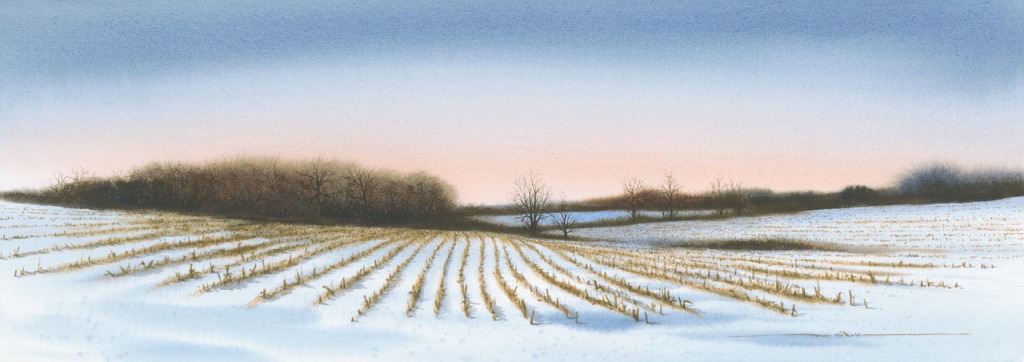
I see the truth and beauty of the Midwest in the skeletal tree branches, the gently undulating hills. (My husband says they’re not actually hills because he’s from Pittsburgh, where they have Hills-with-a-capital-H). There’s a simple, stark beauty in the frost reflecting off the rows of splintered corn stubble. In the strength and design of the barn frames, even those slowly falling down. In the geometry of the patchwork fields lined with trees and criss-crossing fences. In the early morning sunlight reflecting off the puddles of spring rain in the corners of a field.
Indiana winters are not lush and indulgent like a tropical paradise would be. They’re simple and honest and true. Pure.

But if winter is the bare bones of the landscape, summer overwhelms with its impossible decadence. The green is so extravagant it’s almost embarrassing.
The scenes around us change constantly, growing, fading, transforming, renewing. The only thing that remains consistent is what lies beneath.
Dad wasn’t about dressing things up to make them look better, but about portraying the truth of things at their most vulnerable. At their most real.
Just as he captured that which lies beneath, I think his work appeals to those people who do the same thing. Who meet the needs that people take for granted. The ones who raise the crops, feed the cattle, make things run when they’re broken, and feed you when you’re hungry. The ones who are rarely in the limelight, but are the core of our quality of life. The ones who are pure and steady and honest and true.
Much like he was.
