Moments of Unimagined Beauty
Orcas at sunset, the first shooting star of spring, a snowy owl on a bitterly cold winter morning—once these things were gifts from a power I cannot name, something bigger than me, than all of us.
But how do I think about them now?
Text and Photos by David Krohne
I heard the “whoosh” of the orcas’ blows before I saw them. They cruised near shore in a steel-blue sea, just at dusk, beneath salmon clouds, a moment of unimagined beauty. To see them on my one evening at the entrance to Prince William Sound was a stroke of luck. Luck that I happened to be there. Luck that thirty years before, they, or their parents, survived one of the worst environmental disasters in history.
In 1989, a seismic shift occurred in our relationship to the natural world. The fault line separated two major events. In March, the Exxon Valdez ran aground on Bligh Reef in Prince William Sound. The hull breeched and the ship spilled 11 million gallons of crude oil, forming a 3,000 square mile oil slick that eventually covered 1300 miles of shoreline. Pictures of oiled birds, idle fishing boats, and beaches ankle- deep in black gunk dominated the news most of that spring. We don’t know how many orcas died.
That same year, Bill McKibben published The End of Nature, a book that transformed the environmental landscape. McKibben’s book was the first comprehensive summary of the actual and potential effects of climate change. Equally important though, was his assertion that in the process of changing the climate, we have effectively ended nature. By altering the climate, we have inserted ourselves, and the waste of our industry, into the most fundamental aspect of nature—the weather. No longer is a sunny day or a snowy night simply an act of nature but some unknown combination of natural and anthropogenic forces.
The wreck of the Exxon Valdez epitomized the simple, even naïve, environmentalism we had embraced until then. We could be outraged by an oil spill—outraged that oil was transported through a fragile ecosystem in a ship piloted by an unlicensed third mate because the captain was drunk. For oil spills, cause and effect are obvious. The solutions are also obvious—permits, impact statements, contingency plans, regulations, better ships and better navigation. Oil spills are preventable. Each one, and the changes it spawned, demonstrably reduced the probability of the next. Environmentalism fit the Enlightenment ideal of progress: the world is flawed but through reason and commitment to enlightened self-interest, we can gradually, inevitably, heal and protect our environment. Those were the good old days of environmentalism, when oil spills, DDT, leaded gas, acid rain, and heavy metals, grabbed the public’s attention, generated outrage, and had clear, specific solutions.
When nature ended, we entered a new era of mega events. Weathers that have occurred for millennia now occur at different rates and different intensities. New terms—Atmospheric River, Derecho, Megadrought, Super El Niño—have entered our vocabulary. There is a proposal to add a Category 6 to the Saffir-Simpson hurricane scale. This year’s Super El Niño left much of the northern US warm and snow free while California drowns in flood. As I write this, it’s snowing six inches per hour in the Sierras and one hundred mile an hour winds are piling up fifty-foot drifts. As those winds reach Texas, they drive the Smokehouse Creek Fire that has burned a million acres, 850,000 in just two days.
These events are expected on a warmer earth; they are caused by a warmer earth. But they are unpredictable in the direct, familiar cause and effect tradition of the Exxon Valdez. When nature ended, we left behind the world of simple cause and effect—a tanker run aground, oil spilling from its hull—and entered an unstable landscape of uncertainty and shifting probability distributions. We’ve seen the devastation of hurricanes Irma, Katrina, Ian, and Maria. Which of these can we attribute to climate change? We don’t know and, more importantly, we can’t know. We can calculate the expected number of Category 5 hurricanes in the Atlantic this summer, the chances of an El Niño, and the number of acres likely to burn in the West. But when a mega event occurs, we cannot parse the contributions of climate change and natural forces. We are at the mercy of probability distributions.
The impact goes much deeper. The end of nature was also a psychological, perhaps spiritual, turning point. As McKibben explains, causation matters:
Even as it dawns on us what we have done, there will be plenty of opportunity to forget—at least for a while—that anything has changed. It isn’t natural beauty that is ended; in the same way that smog breeds spectacular sunsets, there may be new, unimagined beauties. What will change is the meaning that beauty carries, for when we look at a sunset we see, or think we see, many things beyond a particular arrangement of purple and rose.
Orcas at sunset, the first shooting star of spring, a snowy owl on a bitterly cold winter morning—once, these things were gifts from a power I cannot name, something bigger than me, than all of us. They required only that I be present and open to receive them. Moments of unimagined beauty once led me to wonder and reverence. But how do I think about them now? Beauty as an industrial artifact leads me to despair.
All this was careening around in my head one afternoon last December as I sat on the shore of Lake Coeur d’Alene, huddled against a rock to get out of the wind. I was waiting for an eagle to do something dramatic in fine light. Every December, eagles gather at the lake to feed on spawning kokanee salmon. On a good day you might see dozens, roosting, soaring, gliding to the water to snatch a salmon. But this year, more than 400 eagles spent December at the lake, a new record.
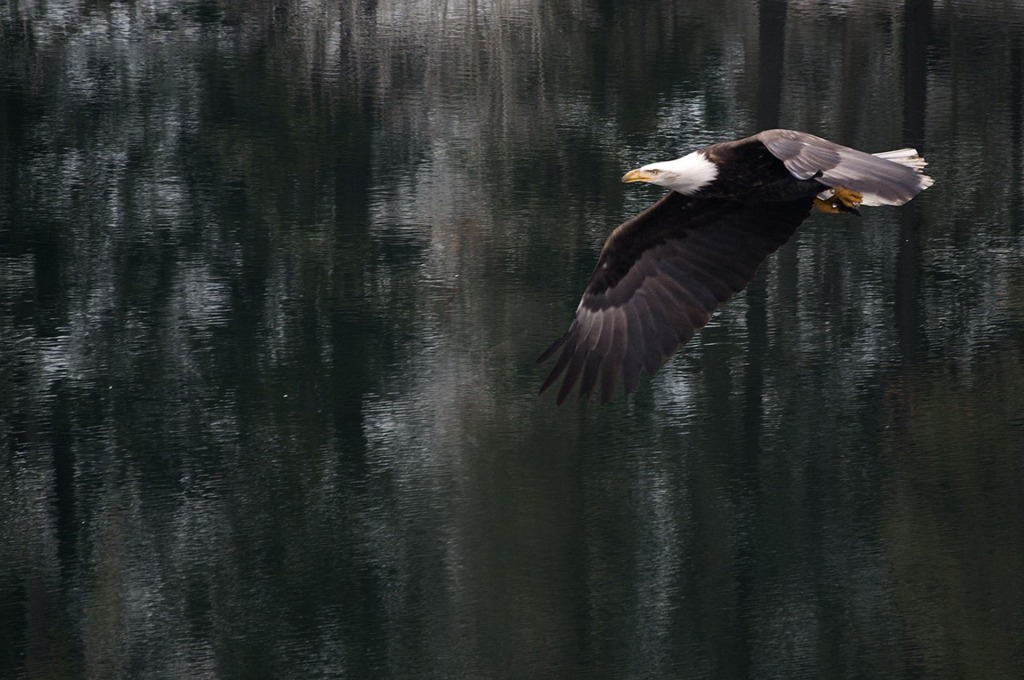
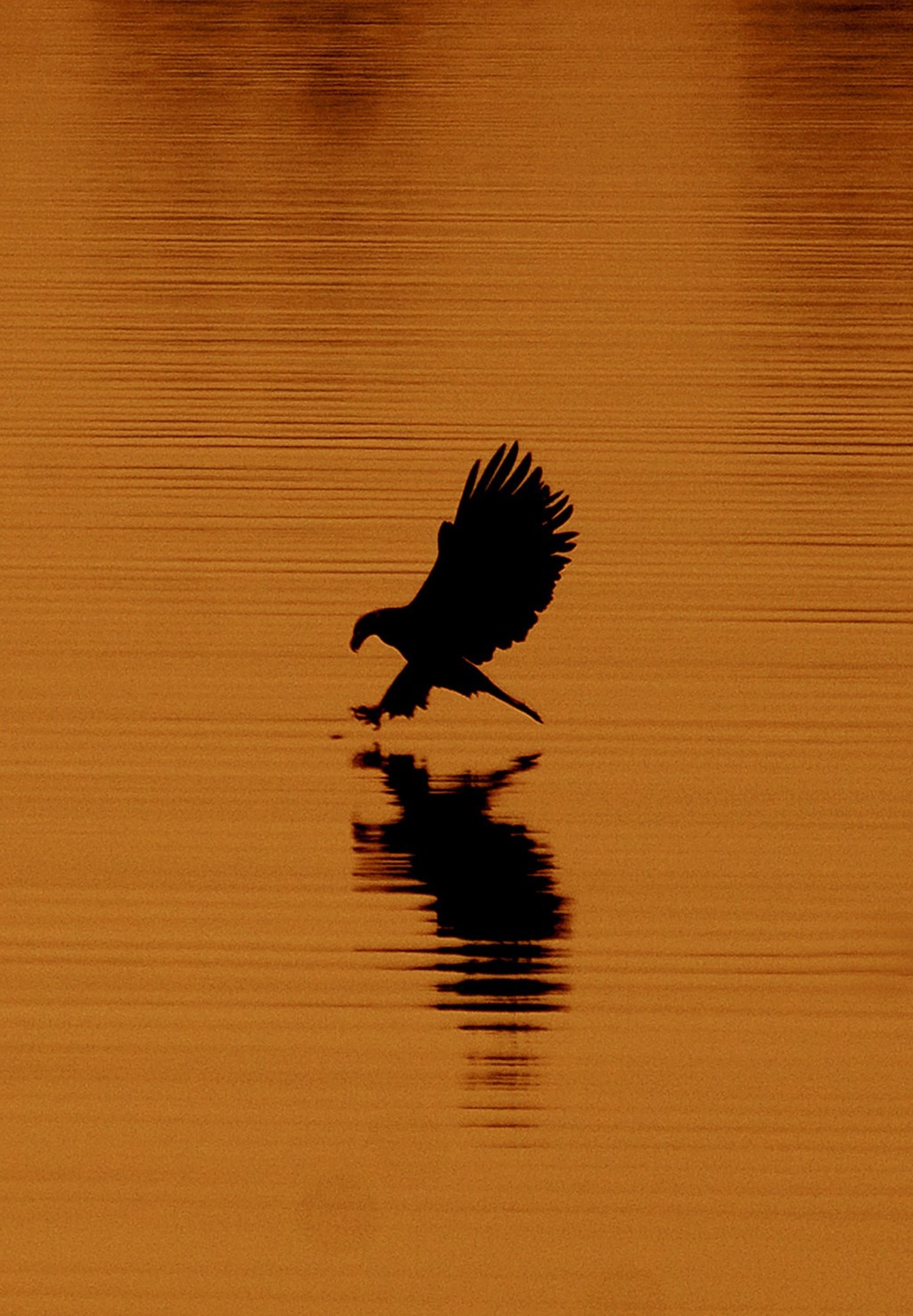
I arrived at the lake that afternoon, hoping for some photos in warm, low angle, December light. But thin clouds hid the sun, leaving the lake and forest in flat, dull light. I took a few dull, flat photographs. I grew colder by the minute, resigned to the leaden sky and dead light but hoping for one brief moment of fine light. Eagles soared, dove, and wheeled in the wind. I wondered how they can even fly with the weight they carry—the burdens of their history and the symbolism we have put on them. From Native Americans to our Founding Fathers, we have asked them to be our symbols of strength, courage, and nation. Their history includes the hundreds that bore the brunt of the Exxon spill as direct mortality or the lingering damage of oil. We nearly killed them all off with DDT. Then, as they recovered, we asked them to be the charismatic symbols of pre-McKibben environmental optimism.
I lingered. Maybe because my subconscious believed there was an image there that I simply hadn’t found yet.
To warm up, I hiked down the shore past an array of perched eagles. One isolated snag held a single bird in dreary, uninspiring light.
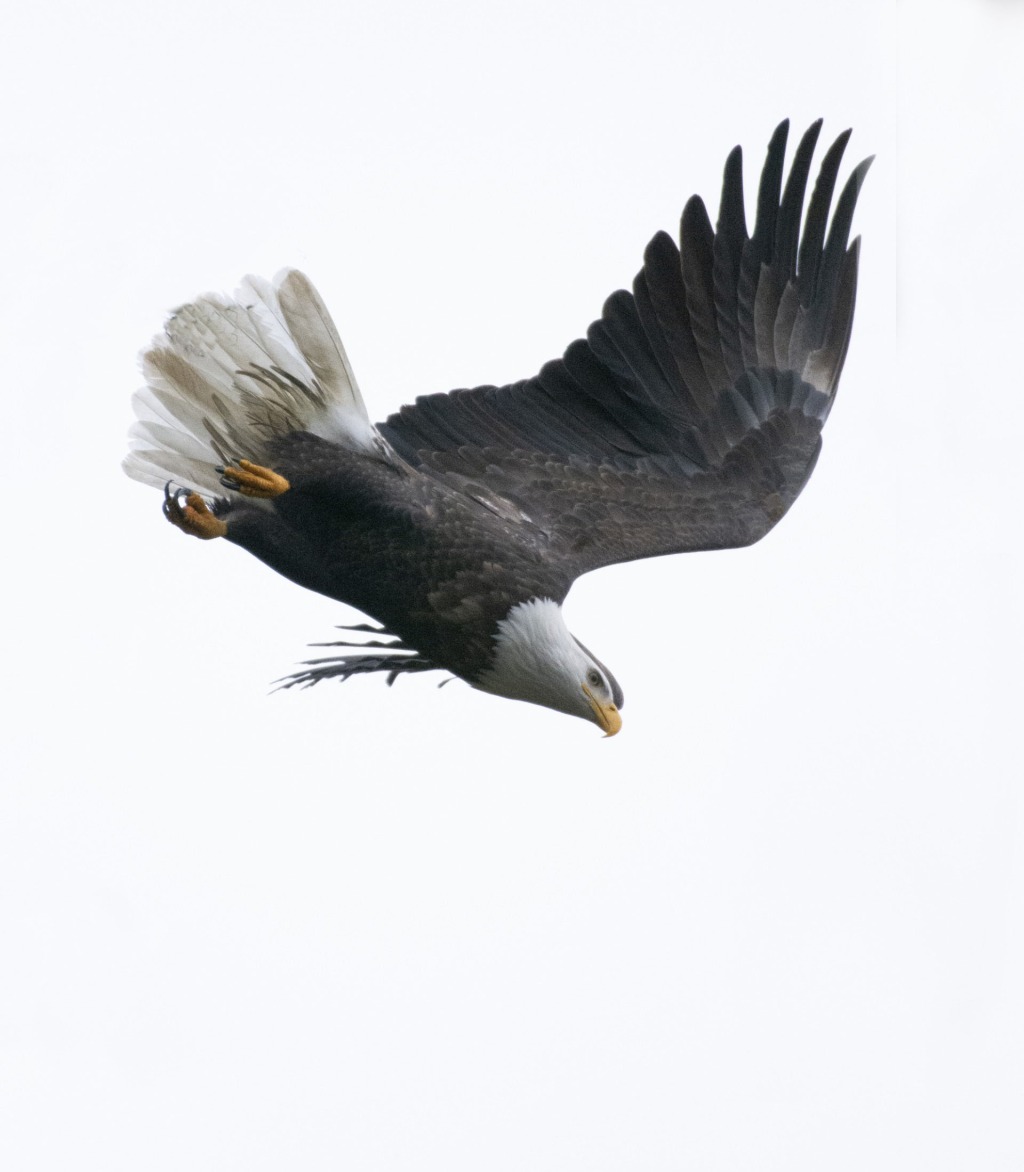
As I watched, its wings fluttered in anticipation of flight. In the moment it left the snag, I found the image my subconscious had been imagining.
It is simply an eagle, in no context but the air, for a fraction of a second unburdened by symbolism, freed from history, its future unknown beyond the edge of the frame.
One thousandth of a second of certainty in an uncertain world.