
Still Here
“Just about the time I’d get something figured out, I’d get blown out of the water by something else.”
by Steve Charles
Photos by Nolan Calisch
Snow was falling in rural Montgomery County a few days before Christmas 2022 and Doug Calisch was back. Back in his art studio for one of the first times since the brain bleed that triggered a hemorrhagic stroke that nearly killed him.
It had been six weeks since paramedics loaded him into an ambulance, six weeks since he was flown by helicopter to St. Vincent’s Hospital, where surgeons opened a flap in his skull to relieve pressure building in his brain, pressure that would have caused further damage. Six weeks since his life as a retired college professor—free to create whatever art he could imagine and furniture he could design—was replaced with days in St. Vincent’s ICU, weeks of confusion and frustration, hours of cognitive and physical therapy with more to come, and questions that no one could answer.
It felt healing just to be home again at Split Cedar Studios, back with his wife, Laura, an artist and yoga instructor, in the house they built together decades ago during one of his sabbatical years at Wabash College. The house where they raised their sons and now welcome their granddaughters.
He was back in the studio where he’d created sculptures exhibited regionally and nationally, work that led him to help others use art as a way to face their grief and adversity at places like Muncie Hospital’s Cancer Wall, work that had deepened his vocation as an artist and teacher who inspired the lives of his students and many others.
During long days in the hospital and care center, he had yearned to get back here.
Now, sitting by the wood stove with his dog, Bones, at his feet, Doug looked at a large table nearby and the pile of found objects he’d collected before the stroke. He wondered how he’d be able to make art again.
Doctors called his a “shotgun stroke,” meaning damage from the hemorrhage was scattered throughout the right side of his brain rather than focused in one specific area. He didn’t lose any one of his brain’s functions completely, but parts of many of them. His vision was impaired. He had some paralysis on his left side. He was struggling with understanding technology, with writing and reading.
And his understanding of symbols, how we communicate without words and how one thing can stand for something else—skills so essential to making art—took a direct hit.
He was told that this first year after the stroke would be the window for the brain’s plasticity, for finding new ways to recover what the stroke had taken. Doug was willing to do any work necessary to get back whatever he could, but no one could tell him how much any of that would pay off, or if he would ever be able to return to his creative life.
“No two brains are alike, and no two strokes are alike,” the doctors said. “We can’t tell you how much you’ll recover, or if you’ll recover.”
In the throes of the stroke he’d seen a line: On one side were all the disabilities he might emerge with. On the other side of the line was death.
“At that moment, you take anything but death,” he recalls. “Bad eyesight? No problem. Forgetfulness, lack of concentration, impairments? When the alternative is death, you accept those things happily. “
But six weeks later, living with those limitations was frustrating, maddening. He knew he wouldn’t be the same as before, but he was reaching for more than this.
By the warmth of the wood stove in the place that had been his creative refuge, workshop, and playground for more than 30 years, he looked at those found objects, remembered his doctors’ voices—”no two strokes are alike”—and peered out the window at the falling snow.
Strokes are like snowflakes, he thought.
It was a beginning.
Nine months later on a breezy, late summer morning, Doug invites me into the studio to see the nearly finished “Stroke in Four Acts,” his found object sculpture that reveals the experience of his stroke and captures his recovery in real time.
I’m excited to see it, ask him to “give me the tour,” click on my recorder, and turn toward the sculpture.
He stops me.
“Before we do that, I need to say something.”
He wants to thank his family—he wants that to be the starting point of anything we write about the piece.
“I wouldn’t even be here if not for Laura,” he says. “We’ve been married 42 years, and now she’s my caregiver. I’m not sure I could take care of myself without her—I can’t even drive. She’s not behind the scenes, she’s in every scene, taking care of us. It’s hard work, and I couldn’t be in the studio working without her encouragement. This wouldn’t be here—I wouldn’t be here—without her.
“And our boys, our sons, Nolan and Sam, they dropped everything important in their own lives to rush to my side and be there for me.
“I can’t look at this piece and think, Right on, Doug. I say, ‘Right on, us.'”
He tells me about a dream he had when he was first regaining consciousness after the stroke: “I was floating in this horse trough, my body almost as fluid as the murky water, my legs and feet were thinning out as the vortex was sucking me down into this dark hole. I looked up and saw my family standing over me, and beneath me their bare feet were reaching into that vortex to catch me, to hold me up. They were not going to let me get pulled in. In my dream, they saved me. And they have.”
He tears up remembering the moment.
I’ve been writing about Doug Calisch’s art for 25 years, and he’s never started a conversation like this.
“Well, this piece is different,” he says.
And it is.

Doug is usually reluctant to share the story behind the sculptures he makes. The whole idea behind using found objects, which come with their own histories, is to allow the audience to see a piece, respond to the objects, and come up with their own stories.
But “Stroke in Four Acts” is his personal story. He hopes the found objects will still work their magic and inspire viewers to find their own stories, but this piece has a definite narrative arc, based on the four phases of his stroke and recovery. He built it from the bottom up, beginning with the moment he regained consciousness at the hospital and felt like “a crusty, 68-year-old newborn awakening into a strangely unfamiliar world.”
“I was in the shadows and very timid for a while, and that’s not at all how I had come at the world before the stroke,” he recalls. “But I couldn’t understand what I was seeing. I would see a squiggly shape that was different from the color of the background, but I didn’t know it was the letter “S”, or any letter of the alphabet; didn’t understand the concept of an alphabet, either. That was all gone—that history of symbols—and I had to rebuild that.
“So this bottom part of the sculpture is meant to be random, claustrophobic—the baby is in a corner, in the shadows, trying to feel safe while all these symbols and things he doesn’t understand are thrust at him.”
“Stroke in Four Acts” is Doug’s most emotional work. He’s infused that first act with confusion, and you can hear the frustration as he describes those early days after the stroke.
“It was like this bombastic obstacle course, where just about the time I’d get something figured out I’d get blown out of the water by something else, and I was being knocked around like a ping pong ball.
“And the stroke took away my workarounds—those ways I’d found to compensate for skills I hadn’t been particularly strong at as a kid. The stroke took those workarounds away. So those things that I had struggled with as a boy, I was struggling with all over again.”
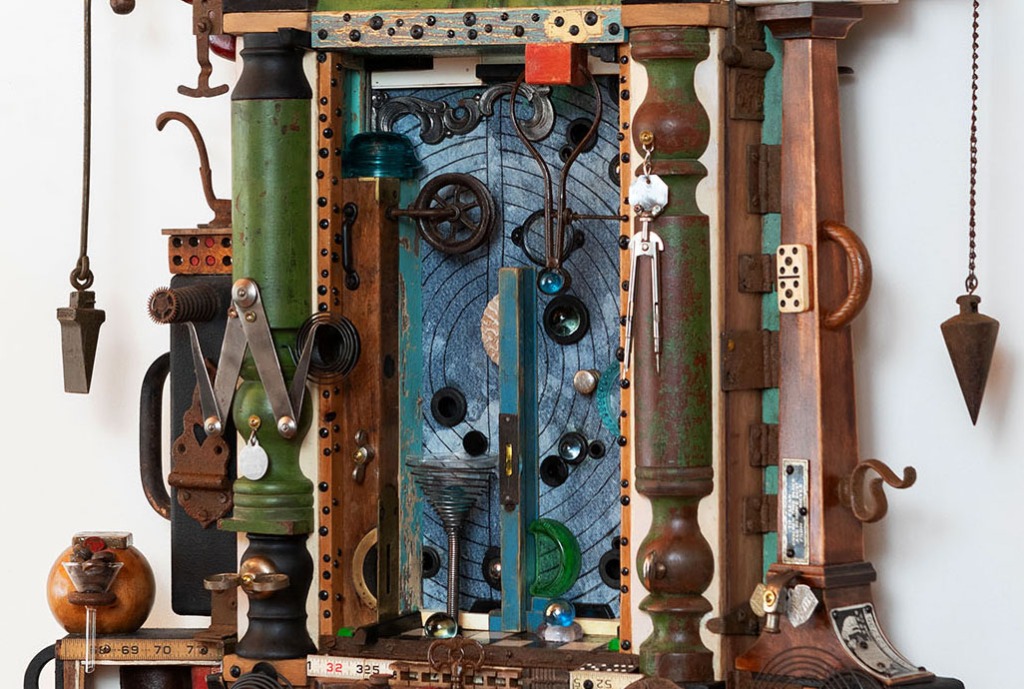
Doug describes the second phase of his recovery as “a sort of out of body experience.” The background of this section is sky-blue (fabric from a pair of his old denim work pants). There’s a level down the middle, like a search for equilibrium, two vertical columns trying to make a foundation, and a piece of brain coral near the center.
“I wasn’t quite as overwhelmed during this phase: I’m glad to be alive, but I’m high above it all; looking at life almost as a spectator. I can see things, but I’m not in them. And there are big holes in this section. Some represent loss of vision, blind spots, and others stand for the information and the knowledge I lost.”
There’s also a funnel-shaped spring.
“I’m not sure this works, but the idea is that this funnel would carry some of the grace of the second phase back to my memory of that overwhelming first phase.”
Part of that grace is music.
“Throughout that first confusing phase, I kept hearing my grandmother’s voice in my head singing “The Horses Run Around,” this nonsensical song she sang to me when I was a child. She died when I was six years old, so this memory has to be around the time I was four or five. This silly song in a comforting voice.
“I’m not musical; I don’t read music. But I think of music as necessary for the human spirit, and it certainly was for me.”

The third act is striking in its simplicity. Perched on those two vertical columns of the second phase are a level and a scale, with calipers dangling just beneath them.
“The many straight lines and angles here make me think of my geometry class in high school,” Doug says. “That was the moment school finally made sense to me, was no longer a task, and the class that opened up everything, cleared out some of the clutter and pointed out what was true to me. I finally had a place in school, a place as a learner.
“This phase of my recovery was a little like that: there are calipers, measuring devices in the sculpture—I’m sizing it all up as I recover, trying to find my place. This section is more refined, and the level suggests I’m striving for balance, equilibrium, and a steady foundation from which I can continue to press up against the limitations the stroke has created, to break through what’s been so hard for me to understand.”
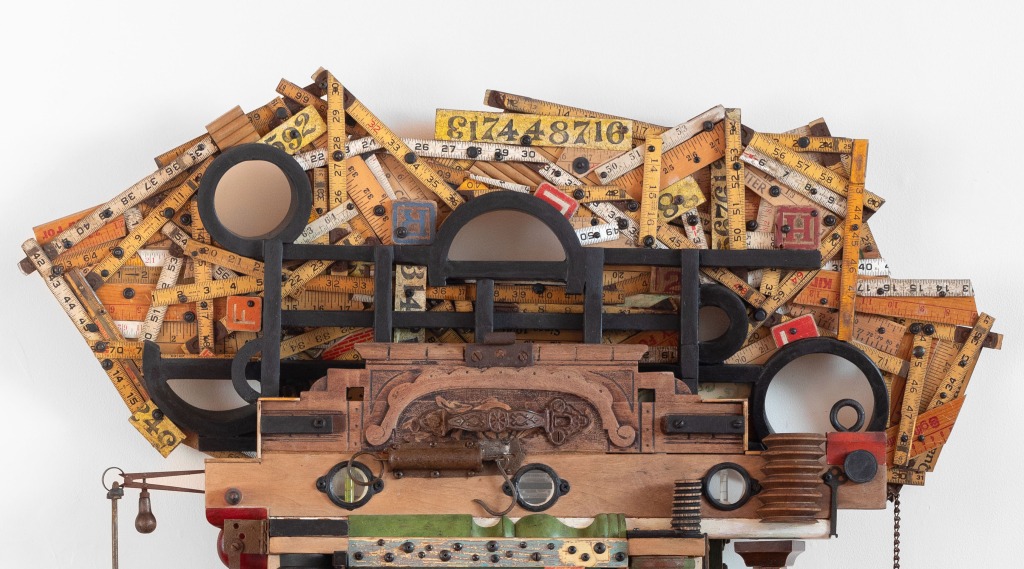
The fourth and final act, appropriately at the top, portrays the strong contrast between before and after, loss and hope.
“It is the way my brain used to work, compared to what’s happening in my brain now,” Doug says. “The black foundational lines are the original neural pathways in my brain before the stroke. The shortest distance to an answer is a straight line, but there are fewer of those pathways left. The circles are times a path leads you around to a question that is the answer. That was how my brain worked before the stroke.
“All the scattered rulers, all the random numbers, all the chaotic lines—that’s the way my brain works now. Because some of the neurons there have been damaged, and some have been destroyed, I have to find another path.”
The pile of rulers looks like it’s being pushed up from below, as if he’s still trying to break through.
“So my brain is still adapting, developing these new workarounds, although I can feel that changing. It’s harder to push through than it was earlier in my recovery.
“As chaotic as all of this may appear, as uncontrolled as it seems, understanding it this way gives me at least the illusion of control.”
From bottom to top, “Stroke in Four Acts” follows a chronological, emotional, and developmental timeline. From the almost claustrophobic literal choices of that first act to the out-of-body abstractness of the second to the refined simplicity of the third and the push to breakthrough of the fourth, not only have Doug’s choices of objects changed, but also his confidence and his capacity to think more abstractly.
“Back in my early phases I was thinking more like, this could be helpful to share with people, and it was pretty literal. But as time went on I moved away from that, because I wanted to be more poetic, a little less straightforward. I don’t want to be a stroke TV commercial, because who am I to say what someone else has or might experience, when no two strokes are alike?
“I’ve taken some liberties, so now you can look at this and you won’t necessarily know it’s a representation of the stroke. But I still want to tell that story, and I’m hoping that, with a little direction, I can make it more clear for you.”
It has taken nine months and change for Doug to complete this piece.
“It was therapy in a very real way,” he says. “For coordination, vision, and cognitively, thinking through the process, how all these pieces were going to come together, what gets painted first, what gets glued first, what’s the order of operation. This has been an incredibly valuable tool for my recovery.
“Sometimes I felt like Geppetto trying to bring Pinocchio to life. Sometimes the boy I was bringing to life was the sculpture, sometimes it was me.
“At first, a lot of it was about pushing back against the stroke—there’s this defiance thing in me, and my first impulse was to say ‘Fuck you, stroke. See—you can’t stop me. I can still make art.’
“Ultimately, the stroke comes back and says, ‘You can make art if I let you. Think what you want, but ultimately this is my call.’
“And the stroke is right.”
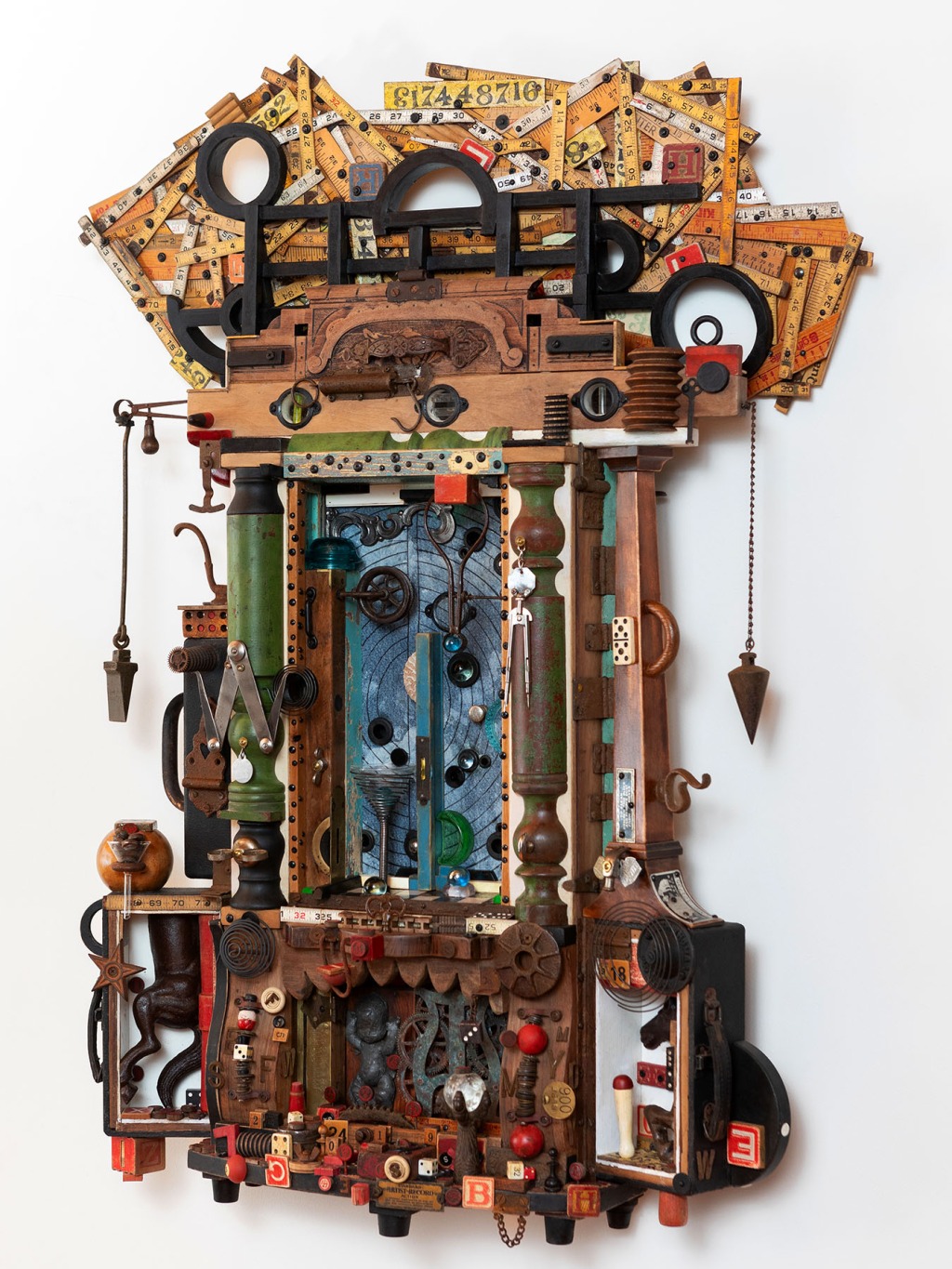
“Stroke in Four Acts” will mean different things to different people. Stroke survivors and caregivers may see some of their own experiences; neuroscientists will see a tangible demonstration of the plasticity of the brain; fellow artists and writers may take heart being reminded how essential our need to create is, no matter what gets thrown at us.
As a friend who has written about Doug and his work for years, I see in this piece a good man knocked down but falling upward, confused, defiant, determined, searching, and grateful to be loved. I see an amazing brain rewiring, skills returning, humility and a new wisdom. There’s motion to this piece—a man rising from the ground, standing up and reaching out—and emotion moving from fear to hope to resolve. I look at it and think of conversations Doug and I have had during his recovery, words I hope I can hold onto to face whatever comes my way.
And I see beauty, in the man and the work, the way the Irish poet John O’Donohue put it: “An emerging fullness, a greater sense of grace, deeper sense of depth, and also a kind of homecoming.”
Three weeks later, nearly autumn, we’re moving “Stroke in Four Acts” from the studio to its place in Doug and Laura’s house.
When I arrive at the studio Doug tells me “it’s a hanging day,” and I realize he means that we’re going to hang the piece, and it’s going to be just us doing the moving.
“Are you sure you want to entrust carrying nine months of your hardest work to a stroke survivor and an old man with bad knees?”
He laughs. We’re doing this.
Getting this piece into the house will mean it’s finished, so Doug can put this chapter in the rearview mirror and make room for the next project. It needs to be included with his other work in the house so that he and his family can move forward to life with, as he sometimes puts it, “Doug 2.0”.
Doug knows even thinking about a next project is a gift. But he says there are more important things first. Laura will be home from teaching yoga soon. And this weekend is Doug’s birthday, and Doug’s mother will be stopping by. In two weeks, he and Nolan are taking a trip to California to spend time with Sam, only Doug’s second cross-country trip since the stroke and a time of celebration with his sons.
After we hang the sculpture on the north wall, I tell Doug how, when I first visited him in the studio nine months ago, six weeks after the stroke, I was shocked that he was on his feet.
“I was just grateful that you were still here, on your feet, talking,” I say. “That was enough—I couldn’t have imagined you’d be creating this. It’s pretty miraculous.”
I ask him how it feels, looking at this piece he’s worked on for so long while recovering, finally finished and where it belongs.
Doug takes it all in for a moment, looking at “Stroke in Four Acts” hanging within sight of the stone fireplace and hearth in this home he and Laura built together. Several of his other sculptures are on the walls, too, along with Laura’s work, his photography, and photographs of his family.
“It fits,” he says. “You can see how it fits in with all the other work.”
He smiles and looks at me.
“I’m still here. I like that.
“I’m still here.”
Read Doug’s words and see close-up photos of “Stroke in Four Acts” here.