Turn, Turn, Turn
A Verdant Meditation on Time and Space
by David Krohne
The trail to Luna’s Run hugs the bank, just a foot or so above the river. Elk created the path, coming down from the ridge line above to drink. It parallels the river for a few hundred yards, then swings back upslope into the black timber. Fishermen use it, but not many. The run, one of the best on the St. Joe, is almost invisible from the road and most “road anglers” have no idea it’s there. Luna’s Run is a little play on words. When I first discovered it, Luna christened it by running nearly a half mile through the shallows in pursuit of a female merganser feigning a broken wing while her twelve chicks huddled quietly in an eddy on the far bank. Luna eventually returned, wild eyed and tongue hanging out. The female clucked from downriver and the chicks scurried away, Luna intent but too hot to start a new chase. And so, Luna’s Run it is.
To reach the path and make the hike to the run, requires a river crossing. In June, when the river first comes into shape, the crossing can be perilous. The river is cold and ripping. A slot just off the bank nearly overtops my waders but then the river shallows up a bit. Still, the current pushes hard. If I hesitate a moment between steps, the turbulence my boot creates washes the gravel and stones away, leaving me unsteady and questioning the whole enterprise. It’s deep enough that Luna has to swim it.

She’s a professional—at any water level she chooses exactly the upstream angle to take so she reaches the far shore at precisely the point the path begins.
The path lies just a foot or two above the June water level. Water pools in elk tracks, usually a cow and her twin calves. Once, a fresh set of cougar tracks just hours old, mingled with the elk tracks and I felt the hair rise on the back of my neck. I could imagine the elk testing the air and not liking the result.
All winter, at my fly-tying bench, I look forward to the first slog through the June mud. I know the shooting stars will be pushing up through the new grass—pink, deep purple, a few bright-white. No flower is as intertwined with my life as shooting stars. In college, when I spent every possible moment in the tall grass prairie, they were the first color emerging from the mat of last year’s grasses. In our California years, when we discovered the Sierra Nevada, climbing, hiking, and the “freedom of the hills”, we could count on them ringing the tarns above tree line. We found them too on our first epic trip to the North Slope in Alaska. There they gave us momentary respite from the clouds of mosquitoes, endless sedge tussocks, and terrifying river crossings. In our Midwestern years they formed part of a spring ritual. The reward for suffering through a mountain of blue books was a quick field trip in search of shooting stars. A handful of magnificent old growth forests nearby held tiny populations of shooting stars hanging on where a windstorm had opened the canopy to the full sun.

There are beautiful places with no shooting stars. But I know no place with shooting stars that is not beautiful.
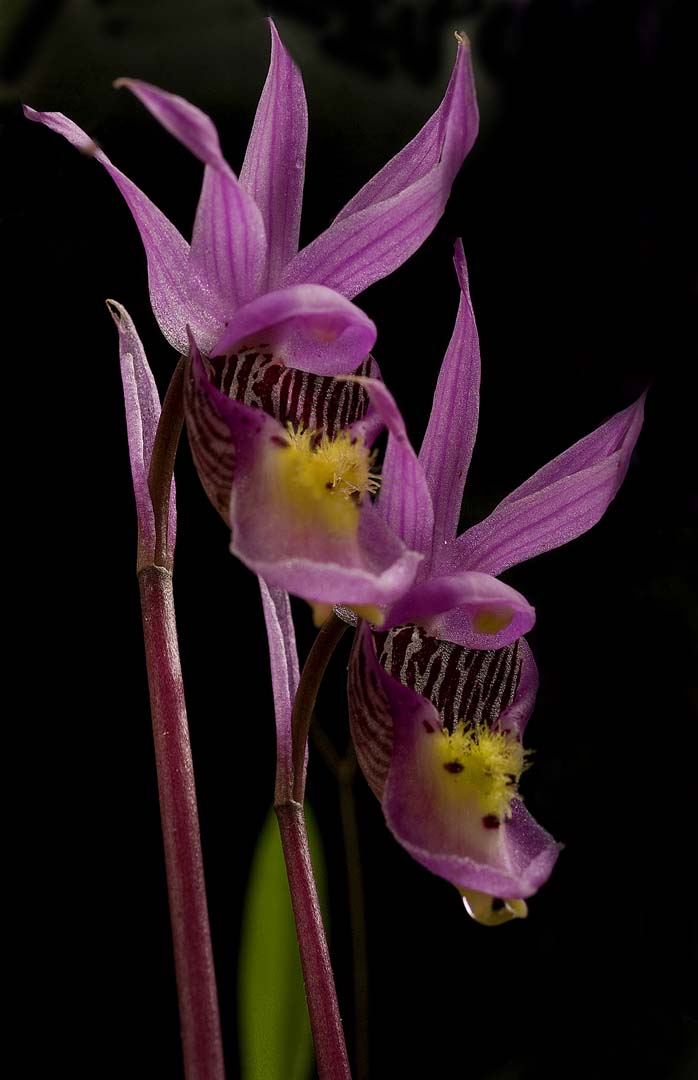
One summer, in late June, Luna wandered up the elk path where it leaves the river to climb back to the safety of the big trees. Frantic barking had me running up the path expecting anything from a bear to a porcupine. We were both lucky—she had treed a pine marten. Fortunately for all of us, it was content to stomp and hiss at this insane wolf-like creature trying to climb a cedar. As I dragged her back to the river, a splash of pink caught my eye. If there is a more exquisite flower than a fairy slipper, I haven’t seen it.
By July the crossing is not so fraught. When the temperature in the canyon hits 90 degrees, 55- degree water on bare legs is a blessing. These are the halcyon days to fish the St Joe. The early spring bugs are still in the air and bringing trout to the surface but a whole new suite of insects is also emerging. It can be difficult to work out which of the five or six bugs on the water the trout are taking but once you do, it can be an epic day.
This is the month of lupine. As diminutive and diffident as June’s shooting stars are, lupines are flamboyant. They demand attention. They bear hairy palmate leaves nearly the size of my hand. If it rained overnight, a drop of water sparkles from the intersection of the leaflets. Whorls of

deep blue pea flowers rise above the grass. I count the species of bees working the deep blue slippers. Each has its own pattern—top-down, bottom-up, random, calm, frenzied.
The lupines on the St Joe are the same species that exploded after the 1988 fires in Yellowstone. When a third of Yellowstone was a sea of blackened trunks, lupines washed the ground with color. They are also prompts for other Arctic memories. After a white water and white-knuckle passage through the Grand Canyon of the Noatak, the river spit out our canoe into a maze of quiet, braided channels. Fortunately, we were still in it. My first grateful step onto solid ground was into a patch of dwarf lupines, a memory that shines as brightly as any I keep. I once made the long pilgrimage to the Hill Country of Texas, where lupines are called bluebonnets. As is everything Texan, this spectacle is gaudy and outsized. But beautiful. Lupines are ubiquitous– Patagonia, Andes, tallgrass prairie, desert, Pacific coast, Baja—there are few places lupines have not accompanied us on our ramblings.
As July slides into August, the lupines fade in the heat. Fewer flowers mark the path and so the paintbrush that dominates has little competition for my attention. My history with paintbrush is long and cherished. Orange and yellow in prairie, cardinal red in the Rockies, magenta in the Cascades, faded orange in desert. The first one I encounter each summer on my path immediately takes me to a summer at the Knox College field station. A tiny opening in the oak woods, Lost Meadow, held a remnant prairie. Native prairies in these little openings were the result of dry, gravelly soil that slowed the growth of trees. Recurring fire was necessary to hold back the encroaching woods. Neglected for years, sumac had invaded Lost Meadow, the first woody species of a sequence that would eventually lead to white oak forest. Fifty summers ago, I bent low with a chainsaw cutting sumac stems until the grass once again felt the full power of the sun. The new grass carried a sumac-cleansing fire. The next June, Lost Meadow was awash in orange. Paintbrush taught me that we can turn back time.

As summer rises into the dry heat of August, fireweed becomes the star attraction. It thrives on the gravel bars wiped clean of plants by the spring floods, but now high and dry as the river drops. The quintessential disturbance plant, fireweed thrives where conditions are harsh and competitors are few. Thousands of downy wind-borne seeds ensure that the next generation finds a new disturbance. The winds have carried them all across the northern latitudes in search of a recent burn, road cut, avalanche chute, or clearcut. In England, fireweed is known as bomb weed. In the bleakest days of the Blitz in World War II, London was dotted with thousands of bomb craters, each bright with fireweed.

you’re a fly fisherman, August is the month you wish comprised the entire summer. The aquatic insects have gone quiet as the water warms. But oh, the grasshoppers. As the canyon browns in the heat, a thin strip of green flanks the river where the water table is high. Every grasshopper in the canyon makes its way down to the only grass worth eating. As I walk the path, the snap and crackle of grasshoppers precedes me, exploding in every direction in crazy, erratic flight. As the air heats in the afternoon and rises through the chimney of the canyon, powerful upstream winds do terrible things to a fly line in the air. But they also carry grasshoppers into the river where trout are conditioned to listen for a “splat” and a Bic Mac struggling on the surface. No longer do I need a stealthy approach or a delicate presentation or precise placement on a current seam. Splat near the bank, wait, set, and hold on. This is the reward for two months of trying to track tiny puffs of feathers in cast after cast until the drift is just right.
One August, and only one, I was stunned to find a tiny patch of twinflower in a moist pocket shaded by a young cedar. I was in love with twinflower long before I ever saw one. In high school I was captivated by a biography of Carl Linnaeus, the Swedish botanist who devised the system of naming and classifying species. I wished that I’d lived when everything was new, when an expedition to Lapland could return with dozens of species no one had ever seen, let alone named. I admired the way he transformed the chaos of life into a logical system. And I loved the way this coldly analytical scientist let his emotions creep into his work: he named beautiful species for his friends and family and weeds and noxious plants for his enemies. A friend who knew how much he loved twinflower, named it Linnaeus borealis after him. Of all the plants in the world, including the 8,000 named by Linnaeus himself, this is the only one that bears his name. Linnaeus contains just a single, circumpolar species. And there it was along the St Joe, flowering at the same time as its namesakes I’ve known in the Yukon, Labrador, Norway, and Alaska.
The first frost brings on the last show on my path, the purples and blues of September. Asters and gentians signal the change from the exuberance of grasshopper feeding frenzies to the gentle sipping of tiny blue-winged olive mayflies. Fringed gentians lined the banks of the Pere Marquette River in Michigan where I finally began to solve the mystery of fly fishing. I’ve had a fondness for gentians ever since. Some asters and gentians also comprise the rarest of the prairie plants—the ones that stop you in your tracks in a South Dakota prairie, ignoring the frantically birdy dog, just before a pheasant explodes at your feet.


In October the air and water temperatures converge. Frost wilts the last of the gentians. A skin of ice grows from the shore in the night. The osprey have left. Elk bugle high on the ridge. Now the river flows gold, mirroring the glow of tamaracks. Just a few rising fish dimple the surface. I have to accept that there will be a last trout.
In a world that feels increasingly unpredictable, I gravitate to the little things I can rely on. There are always flowers on my path, always in proper sequence. They are the river’s calendar. They tell me what insects are on the trout’s menu and what flies to try first. They tell me if the fish will be in the deepest holes of the run, in the boulder field, or in the soft water tight against the bank. I’ll know if the fish I bring to hand will have the first blush of spawning color.
The earth circles the sun on its tilted axis and so the seasons turn, inevitably, predictably. When the last aster fades in October, I’ve aged a season’s worth and my arthritis marks how many casts I’ve made this summer. Luna’s clock runs seven times faster than mine and this October, for the first time, I have to wait for her midstream as she fights the current. At 13, I wonder if she will fish with me when the shooting stars bloom again. Or if I’ll walk the path again. The snow and dark of winter are not far off.
This little sequence of flowers is a meditation on time and space. What meaning do I find here? What metaphor? What allegory? None, none, and none. Each these flowers, individual and species, has a unique trajectory in time and space, independent of each other, the elk, Luna, and me. Why impose the burden of meaning on them? They simply brighten the long walk to Luna’s Run and connect me to the turning of time and memories of chance encounters miles
and years away. I ask nothing more of them.